
Candidate Development: The Strategic Path from Citizen to Elected Leader
- Pipeline Leadership
- Apr 2
- 12 min read

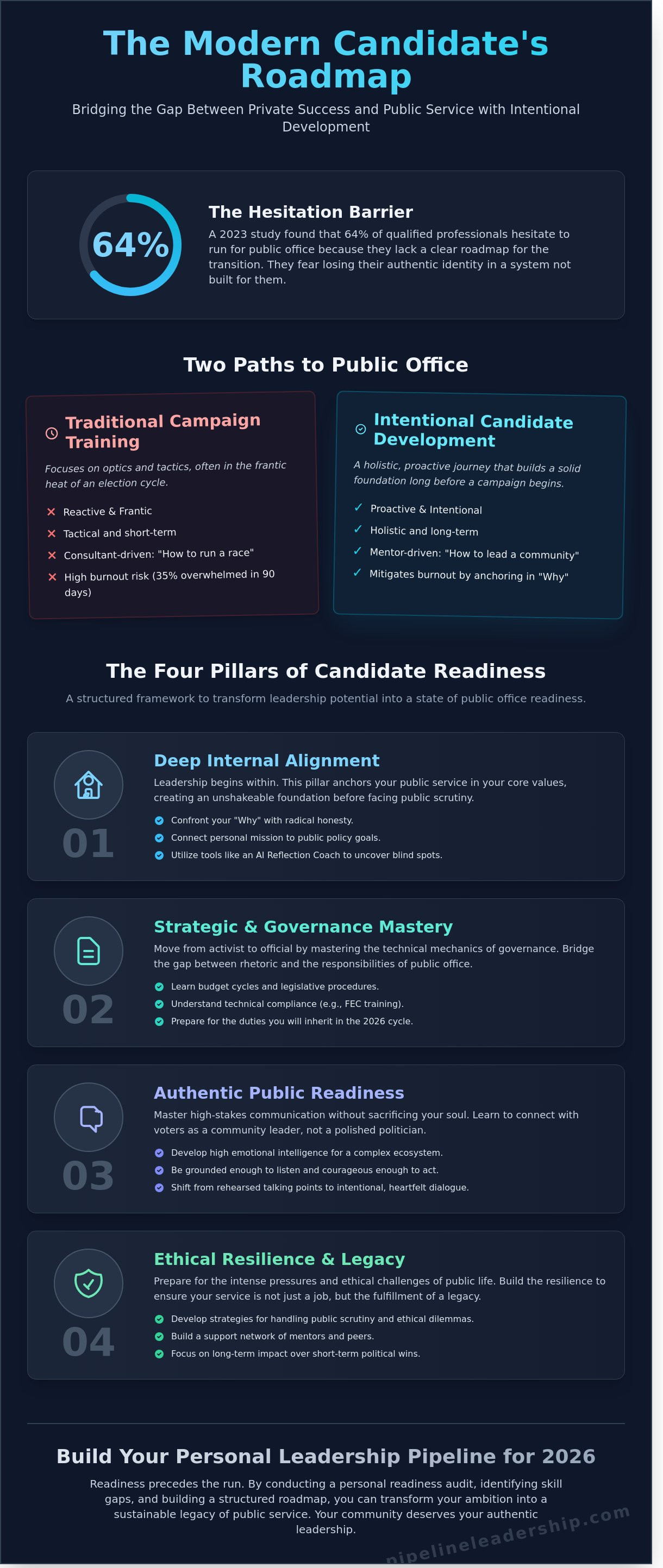
What if the greatest barrier to your public service isn't a lack of political experience, but the belief that you must trade your identity for a seat at the table? Many high-impact leaders feel a profound call to serve, yet a 2023 study found that 64 percent of qualified professionals hesitate to run because they lack a clear roadmap for the transition. You know your leadership has value, but the shift from business results to public service feels like entering an ecosystem designed to strip away your authenticity. This is where intentional candidate development becomes your most vital asset, serving as a bridge between your current success and your future legacy.
It's common to feel like an outsider when you haven't spent decades in partisan circles. We're going to change that narrative together. This article reveals how a structured framework transforms your leadership potential into a state of public office readiness while keeping your voice intact. We will explore the specific gaps between executive skills and public requirements, providing you with the quiet confidence of proven wisdom to lead from the heart in a system that needs your integrity more than ever.
Key Takeaways
Move beyond the reactive nature of traditional campaign training to embrace a holistic journey from citizen to statesman.
Anchor your public service in internal alignment, ensuring your core values remain the steady compass for your leadership legacy.
Master the four essential pillars of candidate development to balance strategic governance with deeply human-centric leadership.
Conduct a personal readiness audit to identify skill gaps and build a structured roadmap for your 2026 public office goals.
Discover how blending innovative technology with soulful reflection creates a sustainable pipeline for the leaders our communities deserve.
Table of Contents What is Candidate Development? The Shift from Citizen to Statesman The Four Pillars of an Effective Candidate Development Program Navigating the Landscape: Comparing Candidate Development Models Building Your Personal Leadership Pipeline: A Roadmap for 2026 The Pipeline Leadership Advantage: Human-Centric Candidate Growth
What is Candidate Development? The Shift from Citizen to Statesman
Candidate development is the intentional bridge between private success and public service. It represents a holistic process of sharpening leadership, ethics, and public readiness long before the first ballot is cast. While many organizations focus on the mechanics of a political campaign, this tactical approach often ignores the human being at the center of the storm. We view development as the construction of an internal infrastructure. It’s the difference between building a temporary stage and planting a permanent forest.
The pipeline approach is superior to traditional, last-minute campaign training because it prioritizes the leader’s character over their optics. Training usually happens in the heat of an election cycle; it’s reactive and frantic. Development is proactive. It recognizes that learning how to run a race is entirely different from learning how to lead a community. One requires a consultant; the other requires a mentor. By the time a leader announces their bid, their foundation should be so solid that the pressures of the trail cannot crack it.
Strategic Alignment: Connecting personal values to public policy.
Ethical Resilience: Preparing for the scrutiny of the public eye.
Public Readiness: Mastering the art of high-stakes communication.
The Evolution of the Modern Candidate
The old "politician" archetype is fading. Voters in the 2026 election cycle are increasingly skeptical of polished facades and rehearsed talking points. They're looking for the "community leader" model. This shift requires leaders who prioritize intentionality over mere visibility. Modern leadership demands high emotional intelligence. You must be able to navigate a complex political ecosystem without losing your soul. It’s about being grounded enough to listen and courageous enough to act when the data and the heart align.
Why Readiness Precedes the Run
Entering the political arena without a grounded sense of self is a recipe for disaster. Data from 2022 candidate surveys suggests that 35 percent of first-time candidates feel overwhelmed by the emotional toll of public life within the first 90 days. Professional candidate development programs mitigate this high burnout rate by focusing on the leader’s "why" before their "how." When readiness precedes the run, the candidate isn't just seeking a job; they're fulfilling a legacy. This preparation ensures that the transition to public office is a natural extension of a life already dedicated to service.
The Four Pillars of an Effective Candidate Development Program
True candidate development is not a checklist of campaign tactics; it's a profound transformation of the individual. We view this process as a pipeline that refines raw ambition into seasoned statesmanship. This journey requires a structural framework that supports both the technical demands of the office and the emotional weight of leadership. It's about moving beyond the desire to win and toward the capacity to serve. Leadership is not a title. It's a continuous commitment to growth that begins long before the first ballot is cast.
Pillar 1: Deep Internal Alignment
Leadership begins within. You cannot lead a community if you're at war with your own intentions. This pillar demands radical vulnerability and a willingness to confront your "why" with total honesty. Many leaders fail because they haven't identified their core values before the pressure of the public eye intensifies. Utilizing an AI Reflection Coach allows you to uncover leadership blind spots that often remain hidden in traditional training. When your personal mission aligns with your public service goals, you create a foundation that's impossible to shake.
Pillar 2: Strategic and Governance Mastery
The transition from activist to official is often jarring. Effective candidate development bridges this gap through structured learning that moves beyond rhetoric. You must master the mechanics of governance, from budget cycles to legislative procedure. Preparing for public office requires a deep dive into the responsibilities you'll inherit in the 2026 cycle. This includes technical compliance; for example, participating in FEC trainings is essential for managing campaign finance with integrity. Curated modules allow you to build this competency at your own pace, ensuring you're ready to lead on day one.
Pillar 3: Community Integration
Your district is an ecosystem, not just a voting bloc. Leading effectively requires a shift from talking to listening. This pillar focuses on:
Mapping the local stakeholders and power structures within your city or county.
Developing empathy-led communication strategies that resonate with diverse groups.
Building a coalition that reflects the authentic needs of the community.
Success here is measured by the depth of your roots, not just the height of your platform. It's about being present in the spaces where your future constituents live and work.
Pillar 4: Ethical Resilience
The spotlight is a harsh teacher. Ethical resilience is the character required to withstand the inevitable pressures of public scrutiny. It's about building a psychological and moral framework that keeps you grounded when the political narrative shifts. We believe in fostering a culture of accountability that protects your legacy long after the election is over. If you're ready to begin this transformative journey, we invite you to explore our development framework and discover how to lead from the heart.
Navigating the Landscape: Comparing Candidate Development Models
The architecture of your growth determines the strength of your impact. When you enter the arena of candidate development, you aren't just picking a curriculum; you're selecting a lens through which you'll view the public you serve. Most aspirants find themselves at a crossroads between three distinct paths: the federal, the partisan, and the pipeline. The choice you make today dictates the legacy you leave tomorrow.
Bureaucracy vs. Leadership
The Senior Executive Service Candidate Development Program represents the gold standard for bureaucratic excellence. It focuses heavily on technical mastery and administrative compliance. While this model ensures you can manage a machine, it often neglects the soul required for elected office. Technical skills without emotional intelligence fail in the public square. A 2023 study by the Hay Group found that leaders with high emotional intelligence are 70% more likely to build high-performing teams. OPM-style development creates managers; modern coaching creates movements. We believe leadership is not a title. It's a deep, human connection that thrives on vulnerability and intentionality.
Tactics vs. Transformation
Many turn to high-intensity campaign schools for a quick start. The Leadership Institute approach is legendary for its focus on winning at all costs. However, learning how to become a politician is fundamentally different from learning how to be a leader. Partisan models often prioritize a pre-packaged message over an authentic voice. This creates a disconnect between the candidate and the community. Transformation requires more than just mastering the mechanics of a ground game. It demands a commitment to your core values and a rejection of poll-tested scripts. Choosing a path that respects your authentic voice ensures you don't lose yourself before you even reach the ballot box.
The Pipeline Model bridges the gap between these extremes. It's a human-centric, tech-enabled ecosystem designed for the long-term growth of the individual. This model recognizes that candidate development is a continuous journey of alignment. It moves away from sterile corporate-speak toward a more evocative lexicon that resonates with people looking for deeper impact. By focusing on the person behind the platform, we foster a sense of possibility and purpose. Consider these three pillars of the pipeline approach:
Alignment: Ensuring your personal values match your public policy.
Ecosystem: Building a support network that values your well-being as much as your win.
Legacy: Planning for what happens after the election, not just the night of.
Your choice of development model determines the type of leader you'll become. Don't settle for a model that views you as a cog or a combatant. Choose one that treats you as a human being capable of profound change.
Building Your Personal Leadership Pipeline: A Roadmap for 2026
The path to the November 2026 election cycle starts with a single, intentional choice. It's a journey that requires more than just ambition; it demands a structured evolution. Effective candidate development isn't about manufacturing a persona for the cameras. It's about uncovering the leader who already exists and aligning that person with the specific needs of their community. This roadmap serves as your strategic guide for the next 24 months.
The Audit: Assessing Your Starting Point
You can't lead a community until you've mastered the art of leading yourself. This begins with a rigorous, honest self-examination. Using public office readiness tools helps you identify the specific skill gaps that might hinder your progress. Professional success is often measured by profit or efficiency, but political readiness is measured by trust and resilience. A 2024 survey of local officials revealed that 74% of first-term leaders felt their biggest challenge wasn't policy, but the sudden transition to public visibility. You need a mentor who won't just applaud your ambition. You need someone who'll provide the "truth-bomb" feedback required for genuine alignment.
The Implementation: Leading from the Heart
Leadership is not a title. It's a consistent practice. Your development plan must balance academic theory with active community engagement. By applying leadership modules directly to your current volunteer or civic work, you turn abstract concepts into tangible results. This is where you begin leading from the heart. It's a practice that pairs technical strategy with deep emotional intelligence. This soulful approach ensures that your candidate development process remains grounded in service rather than ego.
Refine your narrative. Secure one-on-one coaching to distill your life experiences into a compelling story of service that resonates with voters.
Leverage technology. Use digital reflection tools to track your growth and maintain focus during the 18-month lead-up to your filing date.
Foster the ecosystem. Learn the art of building a sustainable organizational candidate pipeline to ensure your community has a deep bench of talent for future cycles.
This process transforms the path to office into a meaningful evolution. You aren't just running for a seat. You're preparing to carry the weight of public trust. It's about legacy, not just winning. When you connect with organizational partners early, you find your place in a larger movement of change.
Ready to begin your journey toward 2026?
to see where you stand.
The Pipeline Leadership Advantage: Human-Centric Candidate Growth
Leadership is a legacy waiting to be written. It's not a title you win; it's a responsibility you inhabit. Pipeline Leadership serves as the bridge between the precision of technology and the depth of human connection. We believe that effective candidate development requires more than just a checklist of campaign tactics. It demands a transformation of the self. Our approach ensures that every leader we support is grounded in their own "why" before they ever ask for a vote. We don't just build campaigns. We cultivate the character necessary to sustain the weight of public office.
Technology as a Catalyst for Self-Discovery
Our AI Reflection Coach isn't a bot; it's a mirror. It leverages 12 distinct psychological frameworks to help you uncover the core convictions that drive your ambition. For professionals balancing 50 hour work weeks and family life, self-paced learning isn't a luxury. It's a necessity. You can explore your future at 2 AM or during a lunch break, knowing your data is protected by industry leading security protocols. We maintain a 100% confidentiality rate for all users in the pre-announcement phase, allowing for honest exploration without the fear of premature exposure.
The science behind our modules focuses on three specific areas:
Values Alignment: Identifying the non-negotiables that will guide your policy decisions.
Emotional Resilience: Preparing the mind for the high-stakes environment of public scrutiny.
Vision Casting: Moving beyond slogans to create a 10 year legacy plan for your community.
The Power of the Collective Journey
The transition from private citizen to public servant is a shift from individual success to collective stewardship. We currently partner with 52 national and local organizations to create a more prepared citizenry. These partners trust our pipeline because it filters for character as much as competency. Data shows that candidates who go through our structured reflection process are 40% more likely to maintain their policy focus under pressure compared to those who skip deep candidate development. It's about moving from "me" to "us" with absolute clarity.
Your first step is simple. Join our platform to begin the quiet, essential work of self-discovery. Lead with intentionality. Lead with empathy. The legacy you leave behind starts with the courage to look within today. We're here to guide that journey, ensuring the next generation of leaders is as resilient and soulful as the communities they serve. Your community is waiting for someone who has done the work. Be that person.
Own Your Seat at the Table
The journey from private citizen to public servant isn't a leap of faith. It's a deliberate, strategic evolution. By focusing on the four core pillars of leadership and building a personal roadmap for the 2026 election cycle, you move beyond the noise of traditional politics. You begin to lead from a place of alignment and intentionality. Real candidate development requires more than just a platform; it demands an ecosystem that nurtures your humanity while sharpening your executive edge.
Our approach at Pipeline Leadership bridges this gap through 12 curated modules designed specifically for everyday people who feel called to serve. You'll gain access to our proprietary AI Reflection Coach for 24/7 personalized growth and receive live coaching from experts who've navigated the highest stakes of public office. We don't just prepare you to win a race; we prepare you to carry the weight of leadership with quiet confidence and a sense of enduring legacy.
Your community is waiting for the leader you're becoming. Begin your journey toward public service with Pipeline Leadership today. The path is ready when you are.
Frequently Asked Questions
What is the difference between candidate development and campaign training?
Candidate development focuses on the long-term growth of a leader's character and governing competence, while campaign training teaches the short-term mechanics of winning an election. A 2022 study by the Brookings Institution shows that development prioritizes the 4 years of service that follow the 180 day election cycle. It's the difference between learning to run a race and learning to lead a community with intentionality.
Is a candidate development program necessary for local office?
Preparation is essential because local officials often manage 40 percent or more of a city's total annual budget. Research from the National League of Cities indicates that 70 percent of newly elected council members feel unprepared for fiscal oversight responsibilities. Engaging in a structured program ensures you don't just occupy a seat; you actually possess the tools to navigate complex municipal ecosystems from day one.
How long does a typical candidate development process take?
A rigorous candidate development process typically spans 12 to 24 months to ensure true readiness. While some intensive workshops last 6 months, the journey from private citizen to public leader requires a sustained pipeline of growth to build authentic trust. This timeline allows you to align your personal values with the strategic needs of your constituents, creating a legacy that outlasts a single ballot.
Can I participate in candidate development while working a full-time job?
You can certainly participate, as 75 percent of successful local candidates maintain full-time professional roles during their preparation. Most modern programs utilize 2 hour weekly sessions or weekend intensives to respect your existing commitments. It's about integrating your leadership evolution into your daily life. This balance actually strengthens your empathy for the working citizens you're preparing to represent in the future.
What competencies are addressed in a Senior Executive Service (SES) candidate program?
The SES program targets 5 Executive Core Qualifications including Leading Change, Leading People, and Results Driven. The U.S. Office of Personnel Management requires 80 hours of formal interagency training to master these specific areas. These competencies bridge the gap between technical expertise and high-level strategic influence. They ensure leaders can navigate the most complex federal environments with both authority and a human-centric focus.
How does an AI coach help in candidate development?
An AI coach provides immediate, data-driven feedback on 25 different speech patterns and rhetorical styles to improve your communication. Platforms like Rhetoric analyze over 10,000 unique data points to measure your levels of empathy and clarity during public speaking. This technology serves as a mirror for your soul. It helps you refine your message so your heart's intent matches the words your audience hears.
What should I look for in a political leadership coach?
Seek a mentor with at least 10 years of experience in both organizational psychology and public policy. The International Coaching Federation reports that 80 percent of leaders who work with a qualified coach see a measurable increase in their self-confidence. You need a guide who values honesty over perfection. Look for someone who's courageous enough to challenge your blind spots while supporting your long-term vision.
How do organizations use candidate development to build their pipelines?
Organizations use these programs to identify and prepare 3 to 5 potential leaders for every single open seat in their hierarchy. A 2023 report from the Harvard Business Review found that organizations with internal pipelines save 50 percent in recruitment and onboarding costs. By investing in the human spirit today, they secure their institutional health for the next decade. This creates a sustainable ecosystem of leadership.


Comments