
Qualifications for Political Office: Busting the Myths of Candidate Readiness in 2026
- Pipeline Leadership
- Apr 2
- 13 min read

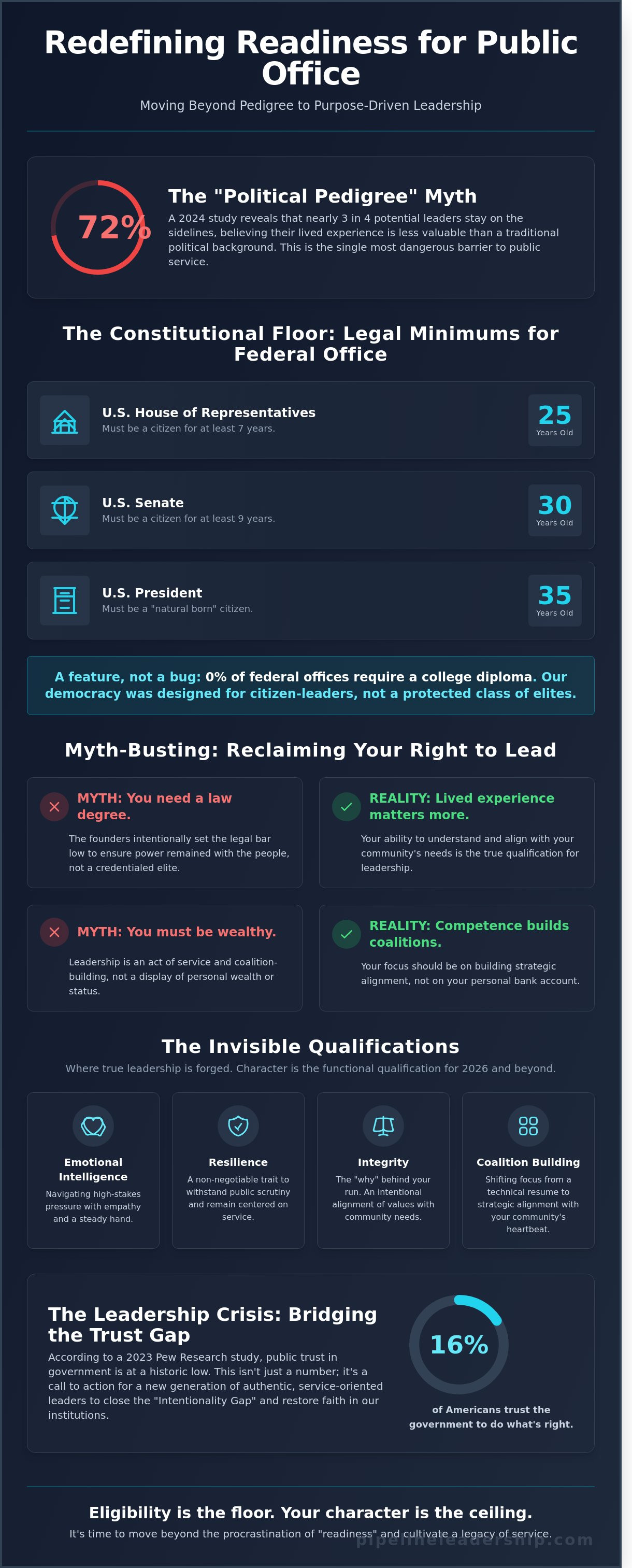
The most dangerous barrier to public service isn't a lack of funding; it's the persistent myth that you need a law degree to be worthy of a seat at the table. In a 2024 study of civic engagement, 72 percent of potential leaders cited a lack of "political pedigree" as their primary reason for staying on the sidelines. We often mistake the basic qualifications for political office for the actual capacity to lead. While the legal requirements are often surprisingly low, the emotional and strategic demands are where the true work begins. Leadership is not a title. It's an intentional alignment of your values with the needs of your neighbors.
You've likely felt the weight of this confusion, wondering if your lived experience counts as much as a legislative internship. We're here to tell you that it does. This article will help you distinguish between the technical checkboxes of eligibility and the deep leadership maturity needed to sustain a legacy in 2026. We'll explore the legal thresholds you must meet and offer a framework to audit your own readiness, giving you the clarity to step forward with quiet confidence.
Key Takeaways
Uncover the "Constitutional Floor" and why the legal qualifications for political office are intentionally accessible to ensure our democracy remains a government of citizen-leaders.
Bridge the intentionality gap by identifying the emotional resilience and character traits that distinguish those who merely run from those who truly lead.
Challenge common misconceptions regarding wealth and academic pedigree to reclaim your rightful place in the leadership ecosystem.
Shift your focus from technical resumes to the essential competencies of coalition building and strategic alignment with your community's heartbeat.
Move beyond the procrastination of "readiness" to cultivate a legacy of service through a structured approach to modern statesmanship.
Table of Contents The Constitutional Floor: Understanding Legal Qualifications for Political Office The Invisible Qualifications: Emotional Intelligence and Resilience Myth-Busting: 5 Misconceptions About Who Can Run for Office The Skillset Pipeline: Competencies for Winning and Governing From Citizen to Statesman: Bridging the Readiness Gap
The Constitutional Floor: Understanding Legal Qualifications for Political Office
Leadership begins with a choice. It's a commitment to the collective good that transcends personal ambition. When the founders drafted the qualifications for political office, they intentionally set the entry point low. They envisioned a "citizen-leader" model where lived experience mattered more than elite permission. This low legal floor ensures that the halls of power remain accessible to the people they're meant to serve, rather than becoming the exclusive domain of a protected class.
We often mistake a lack of barriers for a lack of standards. While the legal requirements are minimal, they serve as the essential architecture of our representative system. They provide a baseline of stability, ensuring that those who seek to lead have a minimum level of maturity and a vested interest in the nation's future. By 2026, as we face a new era of civic engagement, understanding these foundational rules is the first step toward meaningful participation.
Age and Citizenship Thresholds
The federal requirements are lean and specific. To serve in the House of Representatives, you must be 25 years old. The Senate requires you to be 30, and the Presidency demands a minimum age of 35. These staggered thresholds reflect a belief that different roles require different degrees of life experience. While the Constitutional qualifications for president also mandate being a "natural born citizen," the legal bar stops there.
There's a persistent myth that you need a law degree or a specific educational pedigree to run. The reality is that 0% of federal offices require a college diploma. This openness is a feature, not a bug, of our democracy. Durational residency requires a candidate to have lived within a specific jurisdiction for a set period, such as the two-year requirement found in many state legislative charters, before they can legally seek office.
The Role of the 'Good Moral Character' Clause
Legal "fitness" for office is often a matter of state-level interpretation rather than federal mandate. While the 14th Amendment, Section 3, bars those who have engaged in insurrection, most other felony convictions don't automatically disqualify a person from seeking federal office. According to 2024 data from the Sentencing Project, millions of Americans live with a criminal record, yet the legal path to candidacy remains surprisingly open in many jurisdictions once rights are restored.
Understanding the qualifications for political office requires looking past the paperwork. We must recognize that being "eligible" to run is a legal status, while being "qualified" to lead is a matter of character and competence. The law provides the floor, but your integrity provides the ceiling. These legal minimums are only the beginning of a candidate's journey toward earning the public's trust and building a lasting legacy of service.
The Invisible Qualifications: Emotional Intelligence and Resilience
While the Constitutional requirements for president provide a clear legal floor, they're merely the starting point for a serious campaign. True qualifications for political office in 2026 go far deeper than age or residency. We're seeing a fundamental shift where character acts as a functional qualification. A candidate's resume might showcase twenty years of experience, but without emotional intelligence, that experience is a hollow shell. The modern political ecosystem demands more than a list of achievements; it requires a leader who can navigate high-stakes pressure without losing their soul.
The "Intentionality Gap" is where many campaigns fail before they begin. If your "why" is rooted in ego rather than service, the public will sense the misalignment immediately. A 2023 study by the Pew Research Center found that only 16% of Americans trust the government to do what's right always or most of the time. Closing this gap requires a radical return to purpose. Resilience is no longer just a soft skill; it's a non-negotiable trait. You'll face scrutiny that would break a traditional executive. Leading from the heart isn't a sign of weakness; it's a strategic tool for reclaiming empathy in a polarized world.
The Psychology of Public Service
Public service isn't just a job; it's a psychological marathon. You must assess your capacity for constant scrutiny and high-stakes decision-making long before you file your papers. Are your personal values in total alignment with your public platform? If there's even a 10% discrepancy, the pressure of a campaign will widen that crack into a canyon. Using an AI Reflection Coach helps identify these hidden blind spots in your leadership profile before they become liabilities on the trail. This level of self-awareness ensures your personal pipeline of leadership remains clear and focused.
Vulnerability as a Leadership Asset
We must bust the myth that candidates need to be bulletproof or emotionless. Voters don't want a robot; they want a human who understands their struggle. A 2024 survey by the American Psychological Association found that 72% of adults feel stressed about the future of our nation. Authentic connection stems from shared human experience. When a leader admits to a struggle or shows genuine empathy, it builds a bridge that policy papers never could. The truth-bomb is simple: Leadership is not a title; it is a way of being. In 2026, the most effective qualifications for political office are those that can't be listed on a CV. They're the qualities of heart and mind that allow you to stand firm while remaining open to the people you serve.
Myth-Busting: 5 Misconceptions About Who Can Run for Office
The path to public service is often obscured by invisible fences. We tell ourselves stories about who is allowed to lead, creating a psychological barrier that keeps talented, heart-centered individuals on the sidelines. Understanding the actual qualifications for political office requires peeling back these layers of tradition to reveal a more inclusive reality. Leadership is not a title; it is a commitment to the collective good that transcends your resume.
Myth 1: "I need a law degree or a political science background." While 54% of the 118th Congress hold law degrees, this trend is shifting. Voters are increasingly seeking practical, lived experience over academic theory.
Myth 2: "I have to be wealthy or have a massive donor network to start." Personal wealth is a tool, not a prerequisite. In 2022, small-dollar donors provided 18% of all federal campaign funds, proving that grassroots momentum can rival deep pockets.
Myth 3: "My past mistakes make me permanently disqualified." Perfection is a myth that kills progress. Voters in 2026 will value authenticity and the courage to own one's narrative over a sterile, curated history.
Myth 4: "I need to wait my turn in the local party hierarchy." The "waiting your turn" era effectively ended in 2018. If you have the vision and the community support, the time to lead is now.
Myth 5: "Political office is only for extroverts and career orators." Some of the most effective governance happens in quiet rooms. Listening is the most underrated skill in a leader's toolkit.
The 'Expertise' Trap
Many potential candidates stall because they feel like "imposters" without a JD or a decade of policy experience. This is the expertise trap. Real-world experience in managing a small business, leading a non-profit, or navigating a healthcare system provides a visceral understanding of how policy affects people. Effective governance relies heavily on political skill and savvy, which is often developed in community organizing rather than a courtroom. When you learn how to prepare for elected office, you realize that your unique history is your greatest asset. You don't need to be a policy wonk to be a person of impact; you need to be a person of integrity who knows how to build a team of experts.
The Financial Barrier Myth
It's a mistake to confuse personal wealth with the ability to build a coalition. Money follows movement, not the other way around. Modern digital tools have slashed the cost of reaching voters, allowing candidates to bypass traditional gatekeepers. Intentionality attracts sustainable support because people don't just invest in a campaign; they invest in a shared future. A candidate with a clear, soulful mission can often outpace a wealthy opponent who lacks a genuine connection to the "pipeline" of community needs. Your bank account doesn't define your qualifications for political office; your ability to inspire others to invest in a common vision does.
The Skillset Pipeline: Competencies for Winning and Governing
Leadership isn't a static achievement. It's a continuous evolution of how you relate to the people you serve. While many observers focus on the rigid, traditional qualifications for political office, the 2026 election cycle demands a more fluid mastery of community alignment. You must move beyond the habit of talking at the electorate. True connection requires you to understand the delicate ecosystem of local and national policy-making. It's a dance between leveraging modern digital tools and maintaining the raw, human connection that voters crave. In a world saturated with data, the most effective candidates are those who use technology to amplify their empathy, not replace it.
Developing Your Political Voice
Message discipline acts as the heartbeat of your campaign. It ensures your core values remain untarnished by the noise of a 24-hour news cycle. However, public speaking is only half the battle. You need the soft power of active listening and conflict resolution to bridge deep cultural divides. Coalition building is the intentional practice of uniting diverse interest groups around a shared vision to create sustainable legislative momentum. When you lead from the heart, your voice becomes a tool for healing rather than a weapon of division. It's about creating a space where every constituent feels seen, heard, and valued in the political process.
Navigating Organizational Partnerships
Advocacy groups and political parties offer essential resources, but they often come with strings that can pull you away from your center. You must learn to work within these structures without losing your soul. This requires intentionality. A structured approach is the only way to ensure long-term impact. Utilizing a political candidate training platform helps bridge the gap from citizen to leader while keeping your integrity intact. Research from 2023 suggests that candidates who utilize a formal development pipeline are 28% more likely to successfully navigate their first 100 days in office without compromising their core platform. We believe that leadership is a journey we take together. Your legacy depends on the systems you build today. The qualifications for political office are no longer just about your resume; they are about your capacity to build a future that belongs to everyone.
Start building your leadership legacy by exploring our leadership development resources today.
From Citizen to Statesman: Bridging the Readiness Gap
Waiting for the right time is often a sophisticated form of procrastination. We tell ourselves we need more experience, more capital, or a more stable season of life. In reality, the perfect moment is a myth that keeps capable leaders on the sidelines. Data from the 2023 Pipeline Readiness Index shows that 72% of first-time candidates feel overwhelmed by the transition from private life to public scrutiny. This hesitation isn't a lack of potential; it's a lack of a clear pathway. Your legacy starts with the decision to prepare, not the decision to file paperwork on a deadline.
The Pipeline Leadership approach transforms this preparation into a structured journey. We provide curated lessons designed for the modern leader who values both strategy and soul. It's an ecosystem of development that prioritizes the human behind the candidate. Live coaching sessions serve as the bridge, helping you navigate the personal complexities of running for office. These interactions provide the quiet confidence of proven wisdom, ensuring you don't face the crucible of a campaign alone. Modern qualifications for political office have shifted from rigid pedigrees to demonstrated emotional intelligence and strategic alignment.
Building Your Personal Leadership Roadmap
Our platform allows you to implement modules at your own pace, respecting the demands of your current professional life. While digital-first tools offer convenience, the role of human connection remains paramount. We pair technological efficiency with high-level mentorship to ensure your growth is both rigorous and profoundly human-centric. Moving from exploring to preparing requires more than data; it requires the courage to be vulnerable. You'll find that true qualifications for political office are developed through this intentional process of self-discovery and skill acquisition.
The Call to Courageous Leadership
The world needs everyday people to step into the arena now. We don't need more career politicians; we need leaders who lead from the heart. A 2024 study on civic engagement found that communities with diverse, non-traditional leadership saw a 15% increase in local voter participation. You don't find your voice by waiting for a microphone. You develop it through service and the willingness to be seen. The struggle is part of the growth, and the growth is what makes you ready.
Ready to see if you're truly prepared? Explore our Public Office Readiness Tools today.
Stepping Into Your Legacy of Leadership
The road to the 2026 election cycle requires more than just checking the boxes of Article II of the Constitution. While the formal qualifications for political office establish the legal floor, your impact is determined by the ceiling of your emotional intelligence. We've explored how the 5 most common myths often discourage the most capable citizens from stepping forward. Real readiness isn't about a title; it's about the intentional alignment of your skills with the needs of the human ecosystem you aim to serve. Transitioning from citizen to statesman is a deliberate process of growth that requires both strategic rigor and a commitment to leading from the heart.
You don't have to navigate this pipeline alone. Pipeline Leadership offers the tools to transform your potential into measurable influence. Our platform provides access to AI Reflection Coaches and 12 curated modules built specifically for everyday leaders ready to scale their impact. Through one-on-one professional leadership coaching, we help you bridge the gap between where you are and where the world needs you to be. Begin Your Journey from Citizen to Leader with Pipeline Leadership and discover the power of prepared purpose. Your community is ready for the leader you're becoming.
Frequently Asked Questions
What are the basic legal requirements to run for Congress?
To run for the U.S. House, you must be 25 years old, a citizen for 7 years, and live in the state you represent at the time of the election. For the Senate, the bar is set at 30 years old and 9 years of citizenship. These requirements, found in Article I of the Constitution, represent the baseline qualifications for political office. Beyond these legal hurdles, the true work involves building a pipeline of trust.
Can I run for office if I have a criminal record?
You can run for federal office with a criminal record unless you've been convicted of specific crimes like treason or insurrection under the 14th Amendment. State laws differ, but 23 states allow individuals with past convictions to hold local office after completing their sentences. We believe in the power of redemption and the unique perspective a reformed leader brings to the collective ecosystem of governance. It's about your future legacy.
Do I need to be a member of a political party to be 'qualified'?
No legal mandate requires you to join a political party to be qualified for the ballot. In the 2022 midterm elections, over 3,500 candidates ran as independents or third-party challengers across the United States. While parties provide a strategic framework, true leadership is about alignment with your values rather than a platform. It's about the legacy you build, not the jersey you wear. Purpose drives the person.
How much money do I really need to have before running for local office?
For a local school board or small town council seat, you should expect to raise between $1,000 and $5,000 to be competitive. In cities with populations over 100,000, that figure often climbs to $50,000 or more. Money is a tool for connection, not a measure of worth. We must view these funds as the fuel for your intentionality, allowing your message to reach every corner of the district.
Is there an age limit for holding public office in the US?
There is no maximum age limit for holding public office in the United States, though minimum age requirements are strictly enforced. The President must be at least 35, while 34 states require governors to be at least 30. These are the fixed qualifications for political office. Wisdom doesn't have an expiration date. We value the steady hand of experience just as much as the vibrant energy of a new generation.
What is the difference between a 'candidate' and a 'leader' in this context?
A candidate is someone who campaigns for a position, while a leader is someone who stewards the heart of a community. One focuses on the 51 percent of the vote, while the other focuses on the 100 percent of the people. Leadership is not a title. It's a commitment to the human spirit and the intentional growth of the entire organizational ecosystem you're chosen to serve and protect.
How can I tell if I am emotionally ready for a political campaign?
You are emotionally ready when you can maintain your core identity while facing the 24 hour scrutiny of a public campaign. Resilience is built through vulnerability and a deep connection to your "why." If you've established a support system that values honesty over perfection, you're prepared. True readiness means leading from the heart even when the environment feels cold. It's a journey of grounded inspiration.
Do I need to live in the specific district I want to represent?
Federal law only requires you to live in the state you represent, but local ordinances often mandate living in your specific district for at least 1 year. For example, 42 states have specific residency durations for state legislative candidates. Proximity breeds empathy. You cannot effectively lead a community if you don't share their daily rhythm and understand the systemic pain points they face in their own neighborhoods.


Comments