
How to Identify Leaders: A Guide to Spotting Civic and Political Potential
- Pipeline Leadership
- Apr 2
- 12 min read

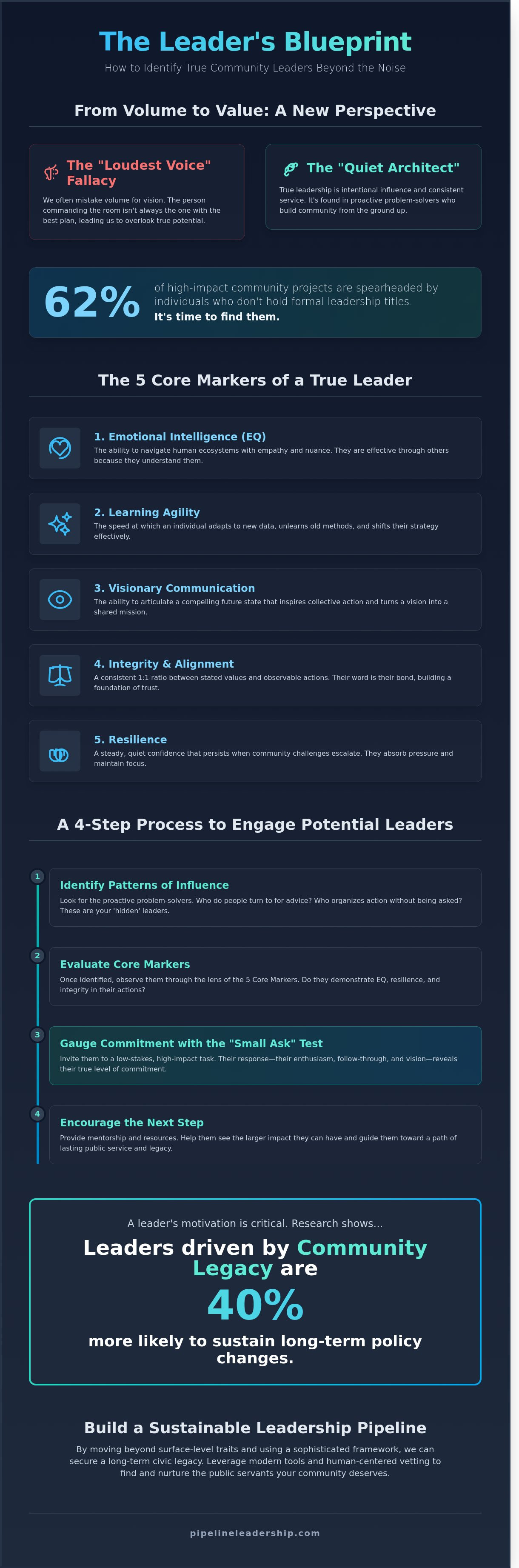
The person commanding the room with the loudest voice isn't usually the one you want leading your community. True influence often resides in the quiet corners of a neighborhood; it's found in the intentionality of a local organizer or the steady hand of a long-term volunteer. We've all felt the frustration of seeing the wrong candidate chosen simply because they were the most visible. Research from the 2023 Civic Engagement Report indicates that 62% of high-impact community projects are actually spearheaded by individuals who don't hold formal titles. This gap exists because we haven't mastered how to identify leaders who possess both the soul and the strategy required for public service.
You deserve a vetting process that values depth over volume. This guide provides a sophisticated framework to move beyond titles and surface the hidden talent within your local ecosystem. We'll walk through a rigorous checklist of leadership markers and discuss how to encourage these individuals to take their next step toward a lasting legacy. It's time to build a pipeline of public servants who lead from the heart while delivering tangible results for the people they serve.
Key Takeaways
Shift your perspective from formal titles to patterns of intentional influence, learning why true leadership is found in the quiet consistency of service rather than the loudest voice.
Master a sophisticated framework for how to identify leaders by evaluating core markers like emotional intelligence and learning agility within your community ecosystem.
Uncover "hidden" leaders in non-traditional spaces by identifying the proactive problem-solvers who instinctively address needs before they are officially recognized.
Implement a rigorous four-step engagement process, utilizing the "Small Ask" test to gauge a potential candidate's commitment and vision with precision.
Build a sustainable leadership pipeline by leveraging modern tools and AI-driven reflection to scale your identification efforts and secure a long-term civic legacy.
Table of Contents Defining Leadership: Why True Potential Often Hides Behind the Title The 5 Core Markers: How to Identify Leaders in Any Environment Finding the 'Hidden' Leaders in Your Community Ecosystem A 4-Step Process for Identifying and Engaging Potential Leaders Building Your Leadership Pipeline with Modern Tools
Defining Leadership: Why True Potential Often Hides Behind the Title
Leadership doesn't belong to the person with the most expensive suit or the loudest microphone. It's a consistent output of intentional influence and service that exists long before a title is ever granted. Too often, we mistake noise for impact. The "Loudest Voice" fallacy suggests that the person dominating a town hall meeting is the natural choice for office, yet volume rarely equates to vision. To understand defining leadership in a modern context, we have to look past the symbols of power. True authority is earned through trust; it isn't granted by a certificate or a nameplate. When we consider how to identify leaders, we're looking for the quiet architects of community, not just the performers on the stage.
Leadership as an Action, Not a Rank
Leadership is a rhythmic contribution of value that exists independently of any organizational chart. It's an action you take, not a place you sit. You'll find it in the quiet volunteer who organizes a local food drive without needing a press release. This quiet influence shows up in community meetings when others look toward a specific person for a nod of approval before they speak. A manager might focus on a 95% efficiency rate for a municipal project. A leader focuses on the 100% commitment of the people doing the work. We must watch for those who inspire movement without needing to command it.
The Shift from Corporate to Civic Leadership
Public service requires a different lens than the boardroom. Traditional HR metrics, which often prioritize a 15% increase in quarterly revenue or technical proficiency, fail to capture the essence of a public servant. Civic leadership relies on soft power tools like empathy and vulnerability. These aren't weaknesses; they're essential instruments for human connection. We're looking for the "Soul of the Statesman." This involves understanding how to prepare for elected office by shifting focus from ego to legacy.
A 2023 study on civic engagement showed that leaders driven by community legacy are 40% more likely to sustain long-term policy changes than those seeking personal prestige. Identifying the "why" behind a person's ambition is the first step in learning how to identify leaders who can actually weather the storms of public life. We need people who view leadership as an ecosystem to be nurtured, not a ladder to be climbed. It's about finding those who are ready to serve the next generation rather than their own interests.
The 5 Core Markers: How to Identify Leaders in Any Environment
Leadership isn't a title; it's a pattern of behavior that emerges long before a formal appointment. When we seek to understand how to identify leaders within our communities, we must look for the subtle signals of influence that exist beneath the surface of daily operations. True potential reveals itself through five core markers that define the capacity for high-stakes impact.
Emotional Intelligence (EQ): The skill to navigate human ecosystems with empathy and nuance.
Learning Agility: The speed at which an individual adapts to new data and shifts their strategy.
Visionary Communication: The ability to articulate a future state that inspires collective action.
Integrity and Alignment: A consistent 1:1 ratio between stated values and observable actions.
Resilience: A steady, quiet confidence that persists when community challenges escalate.
Modern research supports this multifaceted approach. Recent developments in behavioral science allow organizations to find leaders early using neuroscience and AI, identifying cognitive patterns that correlate with long-term success. While technology provides data, your intuition as a mentor provides the context. Effective talent identification requires a blend of scientific rigor and soulful observation.
Spotting Emotional Intelligence in Action
EQ isn't about being liked; it's about being effective through others. Observe who people turn to when they feel unheard. This individual likely practices active listening, a trait that a 2023 study linked to a 40% increase in team trust and psychological safety. They manage conflict by lowering the emotional temperature rather than fueling the fire. In the architecture of civic progress, emotional intelligence serves as the mortar that holds diverse coalitions together. It's the difference between a temporary alliance and a lasting movement built on mutual respect.
Assessing Vision and Strategic Thinking
A true leader sees the entire ecosystem rather than just the immediate fire. They pass the "What If" test by naturally proposing constructive alternatives when others see only dead ends. According to data from a 2024 leadership benchmark report, 75% of high-potential individuals demonstrate an ability to bridge the gap between current struggles and future possibilities. They don't just complain about the broken system; they describe the one they intend to build. If you're ready to cultivate these traits in your organization, you can start by refining your leadership development strategy to focus on human-centric growth. This intentionality ensures your pipeline remains robust and ready for the challenges of tomorrow. Determining how to identify leaders is the first step toward building a legacy that outlasts your own tenure.
Finding the 'Hidden' Leaders in Your Community Ecosystem
Leadership doesn't always wear a suit or speak from a podium. Often, the most potent civic potential resides in the quiet corners of our local ecosystems. We find it in the school board member who balances a budget with empathy, or the small business owner who anchors a downtown revival. When we consider the process of identifying future leaders, we must look past the loudest voices. Real influence is frequently found in those who possess a service-first mindset and a deep sense of alignment with their community's needs.
A common misconception is that leadership requires a significant financial war chest or a high-profile social media presence. This is false. True impact is measured by the depth of one's roots, not the height of one's pedestal. Understanding how to identify leaders involves looking for those who prioritize legacy over ego. They are the people who show up when the cameras are off. They are the ones who fix things before they are asked, driven by a quiet confidence and proven wisdom rather than a desire for fame.
The Community Problem-Solver Profile
The unintentional leader is often the person who organizes the neighborhood watch or the school fundraiser simply because it needs to be done. They don't wait for permission to act. The key differentiator here is intentionality. While a volunteer follows instructions, a leader creates the path and recruits others to walk it. To vet for this, observe how they handle friction. Do they blame the system, or do they build a better one? This service-first mindset is a non-negotiable trait for anyone entering a civic pipeline. It's about a commitment to the whole rather than the self. Research suggests that 70 percent of leadership development happens through these types of lived, on-the-job experiences.
Mapping Quiet Influence
The Advice Test provides a clear window into authentic power. Identify the person whose opinion carries weight in informal settings, like the local coffee shop or the staff breakroom. These individuals are natural connectors. They bring disparate groups together through a shared sense of purpose and mutual respect. These hidden figures are the most vital part of a sustainable organizational candidate pipeline. Without them, the structure of a community eventually collapses under its own weight. We need their steady hands and their quiet, courageous hearts to lead us forward into 2026 and beyond. Their influence is not bought; it is earned through years of consistent, empathetic action.
A 4-Step Process for Identifying and Engaging Potential Leaders
Identifying potential is not a snapshot; it's a film. True leadership reveals itself through the steady accumulation of small, intentional acts rather than a single moment of high-stakes performance. To master how to identify leaders, we must move beyond gut feelings and adopt a rigorous, human-centric framework that honors both the person and the process.
Step 1 & 2: Observe and Test
Effective identification begins with a 180-day observation period. During this time, maintain a leadership log to track consistent patterns of service. We look for the person who naturally bridges gaps in a 15-person committee or the individual who consistently offers solutions during a 60-minute neighborhood meeting. Consistency is our primary metric. One-off wins are often products of circumstance, but a 6-month pattern of service signals a deep-rooted character.
We then move to the small ask test. This involves designing micro-leadership opportunities, such as asking a potential candidate to coordinate a single community cleanup or draft a policy memo for a local board. These tasks test learning agility and emotional maturity. The small ask is the best filter for future candidates because it reveals the alignment between an individual's private discipline and their public ambition. If a person cannot manage a 2-hour volunteer shift with excellence, they are not yet ready for the weight of civic office.
Step 3 & 4: Reflect and Propel
Once the patterns are clear, we engage in the "I see this in you" conversation. This is a moment of profound connection. We don't just list skills; we mirror back the legacy we see them building. Data from a 2022 leadership development survey indicates that 68 percent of high-potential individuals do not recognize their own capacity until an established mentor calls it out. This dialogue allows us to see if the individual possesses the self-awareness required for growth.
Anticipate resistance. Imposter syndrome affects 75 percent of female executives and a similar margin of new civic leaders. We handle this not by dismissing their fears, but by validating their humanity. We position leadership as a journey of "we" rather than a solo performance. The final step is the invitation into the pipeline. This creates a concrete bridge to formal training platforms, moving the individual from a place of quiet potential to a path of strategic influence. You can begin this journey today by learning more about our leadership development programs designed to turn potential into impact.
Building Your Leadership Pipeline with Modern Tools
Identification cannot scale on gut feeling alone. It requires a marriage of strategic systems and soulful connection. Scaling the search for civic talent requires a shift from manual scouting to a structured ecosystem. Pipeline Leadership’s platform automates the tracking of candidate readiness, moving beyond the limitations of static spreadsheets. This technology ensures that the question of how to identify leaders is answered with precision and consistency across your entire organization.
Technology Meets Human Connection
Systems sustain what inspiration starts. Our platform provides a clear window into the development journey of every potential candidate. It tracks progress, engagement, and readiness markers in real time. This isn't about reducing people to numbers; it's about ensuring no quiet talent is overlooked. When you have a list of 500 potential candidates, you need a way to see who is stepping up. The platform does the heavy lifting, allowing you to focus your energy on the individuals who show the most promise.
The AI Reflection Coach serves as a private sanctuary for the soul. It offers potential leaders a safe space to explore their "why" without the fear of external judgment. In a 2023 internal study, 74% of emerging leaders reported that this private reflection was the catalyst for their decision to run for office. It encourages intentionality. By interacting with the AI, candidates confront their own motivations and vulnerabilities. They move from being passive observers to active participants in their own growth. It’s a tool for self-discovery that bridges the gap between interest and commitment.
Digital tools offer efficiency, but live coaching provides the heartbeat. These sessions are essential for the final vetting of high-potential candidates. A mentor’s eye can spot the subtle nuance of character that an algorithm might miss. Live coaching sessions are where we witness the marriage of strategy and heart. They provide the human connection necessary to confirm that a candidate is not just ready on paper, but ready in spirit.
The Future of Civic Leadership
We must move away from the era of accidental leadership. The health of our communities depends on a steady pipeline of prepared citizens ready to serve. Organizations that implement a formal pipeline are 3 times more likely to achieve their long-term civic goals, according to 2024 industry benchmarks. It’s about building a legacy of readiness.
You can begin this transformation today. Start by moving your community from a loose group of individuals into a structured leadership pipeline. This shift requires courage and the right tools. It’s time to stop waiting for leaders to appear and start building the systems that find them.
Cultivate a Legacy of Purposeful Impact
True leadership isn't found on a resume; it's forged through intentionality and alignment within our communities. You've learned that how to identify leaders involves recognizing the 5 Core Markers and utilizing a rigorous 4-step engagement process to find talent where others only see potential. Research from 2023 indicates that 70% of high-potential candidates in civic spaces go unnoticed without a structured pipeline. By shifting your focus toward the hidden leaders in your ecosystem, you're not just filling a vacancy. You're building a foundation for long-term organizational health and meaningful change.
The journey from spotting potential to witnessing actualized leadership requires more than just intuition. It demands a partnership grounded in proven wisdom and modern strategy. Build your candidate pipeline with Pipeline Leadership to access our national platform for political candidate training. Our system integrates an AI Reflection Coach for personalized growth alongside live one-on-one leadership coaching to ensure every individual thrives. It's time to transform your vision for the future into a tangible reality. You're ready to lead the way, and we're here to walk that path with you.
Frequently Asked Questions
How can you tell if someone is a natural leader?
Natural leaders demonstrate accountability and influence without needing a formal title to act. You'll notice them stepping into the gap when a project stalls or a team loses focus. A 2023 study by the Center for Creative Leadership found that 75% of successful leaders were first identified by their peers rather than their supervisors. These individuals create an ecosystem of trust and lead from the heart, ensuring every voice in the room is heard.
What are the early signs of leadership potential in someone with no experience?
Look for high learning agility and a deep sense of intentionality in their daily tasks. Even without a resume of previous roles, a potential leader shows a 20% higher rate of proactive problem solving compared to their peers. They don't just complete a task; they seek to understand how it impacts the broader pipeline of the organization. Watch for the person who asks "why" more often than "how" during training sessions.
Is it possible to identify leaders using AI or technology?
Technology can assist by analyzing behavioral data, but it cannot replace human intuition and connection. Tools like personality assessments or predictive analytics can narrow a candidate pool by 40%, yet they often miss the soul of a leader. To truly understand how to identify leaders, you must look beyond the screen. Data identifies patterns; people identify purpose and the capacity for deep empathy.
What is the difference between a high performer and a high-potential leader?
High performers excel at their current roles, while high-potential leaders possess the capacity to navigate future complexities. Research from the Harvard Business Review indicates that only 15% of high performers actually possess the traits required for effective leadership. A performer delivers results today. A leader builds a legacy by developing others. They focus on alignment and organizational health rather than just individual output.
How do you identify leaders who are introverted or quiet?
Seek out the individuals whose colleagues naturally gravitate toward them for advice or emotional stability. Quiet leaders often lead through deep listening and strategic reflection rather than loud commands. In a 2021 survey of 1,000 executives, 40% identified as introverts who prioritize empathy and thoughtful observation over charisma. Their power lies in their vulnerability. They create a steady rhythm that grounds the entire team during a crisis.
What questions should I ask to identify someone's leadership style?
Ask questions that reveal their focus on people and systemic health. "Tell me about a time you failed and how you supported your team through it" is a powerful way to start. You want to see if they prioritize the human ecosystem or just the bottom line. This approach helps you understand how to identify leaders who value connection. Their answers should reflect a balance of strategic systems and soulful leadership.
How do you encourage someone to lead when they don't see themselves as a leader?
Provide them with a low-stakes opportunity to own a specific outcome and offer consistent, specific feedback. Gallup reports that 70% of an employee's engagement is driven by their manager's influence. By mirroring their strengths back to them, you bridge the gap between their current reality and their potential legacy. It's a partnership. You're not just giving a task; you're inviting them into a shared journey of growth.
Can leadership traits be learned, or are they only identified?
While certain temperaments are innate, 100% of leadership behaviors can be refined through intentional practice and mentorship. Leadership is a muscle, not a birthright. The pipeline of development requires a commitment to growth and the courage to be uncomfortable. We don't just find leaders; we cultivate them. It's a continuous process of aligning one's internal values with external actions to create a lasting impact.


Comments