
How to Run for School Board: A Guide to Purposeful Educational Leadership
- Pipeline Leadership
- Apr 2
- 12 min read

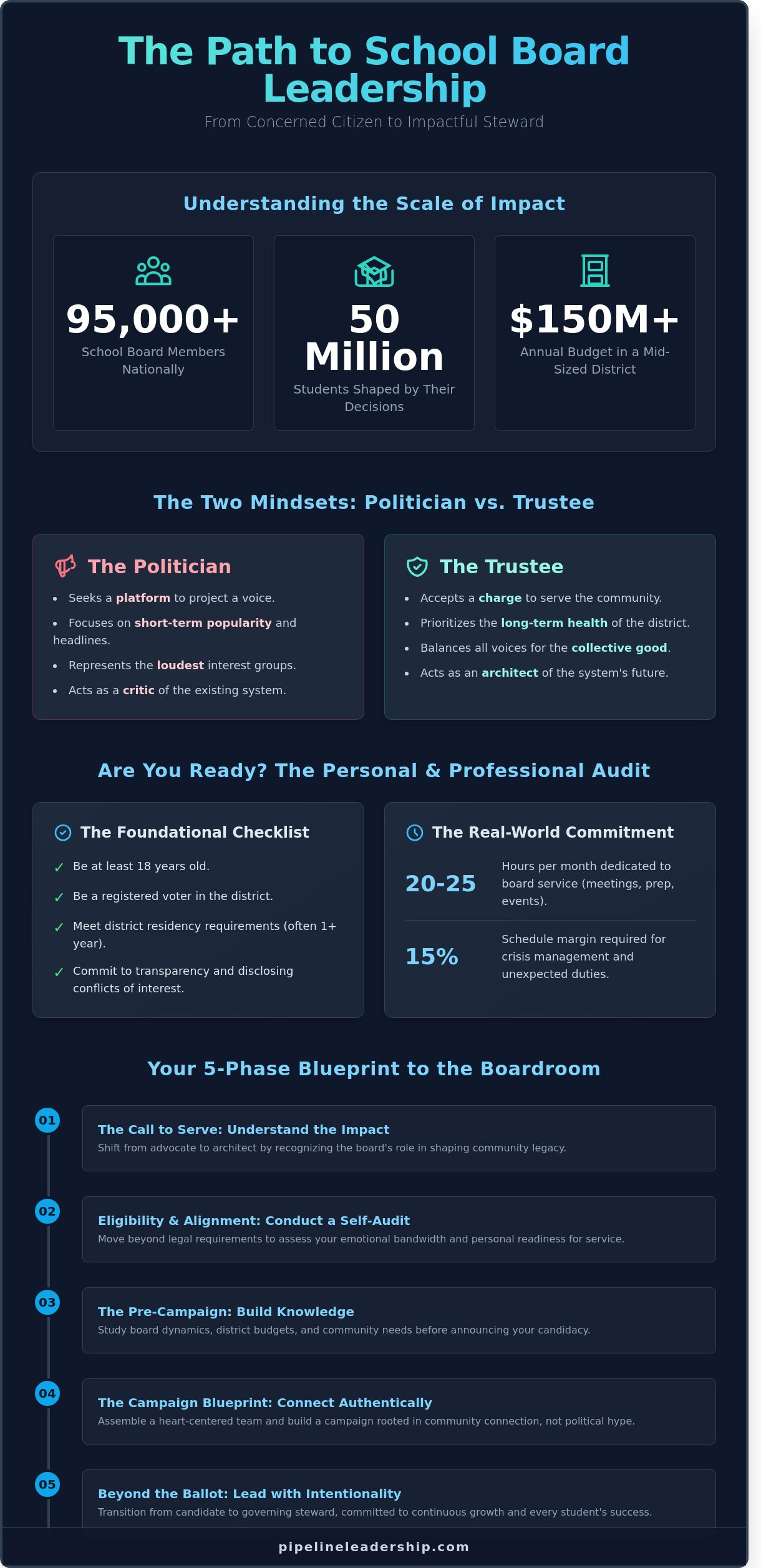
What if the most influential seat in your community isn't in the mayor's office, but in the school board chamber? According to the National School Boards Association, over 95,000 board members are currently shaping the educational ecosystem for 50 million students. Learning how to run for school board is about more than filing a petition; it's about claiming your place in that legacy. Leadership is not a title. It's an act of intentionality that begins the moment you decide to serve.
You've likely sat at your kitchen table feeling the weight of local decisions, wondering if your voice could actually shift the culture of your district. It's natural to feel overwhelmed by complex filing deadlines or the fear that your vision will get lost in partisan noise. We understand that struggle because true leadership requires vulnerability. This guide provides the strategic, emotional, and logistical framework you need to move from a concerned observer to an impactful leader. We'll explore the path to building a coalition, mastering the legal requirements, and anchoring your campaign in a leadership identity that prioritizes people over politics.
Key Takeaways
Transition from a concerned advocate to a systemic leader by learning how to align your personal values with the long-term legacy of your school district.
Master the essential logistics of how to run for school board, from meeting residency requirements to assessing the emotional bandwidth required for high-stakes governance.
Build a foundation of intentionality by studying current board dynamics and budgetary ecosystems well before you announce your public candidacy.
Discover how to assemble a lean, heart-centered campaign team that prioritizes authentic community connection over traditional political hype.
Prepare for the profound shift from candidate to governing steward, ensuring your leadership remains rooted in continuous growth and a commitment to every student's success.
Table of Contents The Call to Serve: Understanding the Impact of School Board Leadership Eligibility and Alignment: Are You Ready for the Pipeline? The Pre-Campaign Phase: Building Your Foundation of Knowledge The Campaign Blueprint: From Filing to Election Day Beyond the Ballot: Leading with Intentionality on the Board
The Call to Serve: Understanding the Impact of School Board Leadership
Leadership isn't a title. It's a heavy, beautiful responsibility. When you decide to explore how to run for school board, you're stepping into a role that acts as the heartbeat of your local community. You aren't just an observer; you're a steward of student success and a guardian of public trust. This transition requires moving from outside advocacy to systemic intentionality. It means moving from asking why something isn't happening to building the structure that makes it possible. You're shifting from a critic of the system to the architect of its future.
The weight of this service is substantial. School board members oversee massive district ecosystems, often managing annual budgets that exceed $150 million in mid-sized districts. They craft the policies that dictate the daily lives of thousands of students and educators. By understanding the role of a school board, you see that these decisions create the foundation for our democratic pipeline. You're not just fixing a school; you're cultivating the next generation of citizens. It's about creating alignment between community values and classroom outcomes.
The Difference Between a Politician and a Trustee
A politician seeks a platform, but a trustee accepts a charge. Leading from the heart means prioritizing the long-term health of the district over short-term popularity. You hold a fiduciary and moral responsibility to every taxpayer and child. While a politician might chase headlines, a trustee balances community desires with evidence-based educational practices. It's a delicate alignment of diverse voices into a singular, student-centered vision. You must be willing to make the difficult, quiet choice that serves the collective good rather than the loudest interest group.
Why Your Voice Matters in 2026
The year 2026 represents a pivotal moment for American education. We're facing a shift in how technology, mental health, and workforce readiness intersect in the classroom. We need courageous leaders who view their professional expertise or parental perspective as a strategic asset. Whether you've managed corporate budgets or navigated the special education system, your lived experience provides the necessary friction to spark innovation. Your decision on how to run for school board today determines the legacy your community inherits a decade from now. We don't need more experts; we need more humans who are willing to lead with clarity, connection, and a focus on the pipeline of talent within our schools.
Eligibility and Alignment: Are You Ready for the Pipeline?
Most people start the journey of how to run for school board by checking the legal boxes. You must be at least 18 years old, a registered voter, and a resident of your district for a specific duration, often one year. While these are the floor, they aren't the ceiling. Leadership is a choice, not a circumstance. True alignment requires you to look past the paperwork and into the mirror. You're entering an ecosystem that demands both technical compliance and emotional fortitude. It's about ensuring your internal compass matches the district's true north.
The Professional and Personal Audit
Serving on a board isn't a hobby. It's a high-stakes commitment that often requires 20 to 25 hours of monthly labor, including late-night meetings, community events, and deep-dive document reviews. Your career and family will feel the weight of this choice. Before you file your paperwork, use this Public Office Readiness Checklist to identify where your current lifestyle might clash with your civic ambitions. If your schedule doesn't have a 15% margin for crisis management, you aren't ready yet. Success requires a steady hand and a clear calendar.
Legal and Ethical Foundations
Integrity is the only currency that doesn't depreciate in the public square. You'll need to disclose potential conflicts of interest, such as family members employed by the district or business contracts that overlap with school operations. Transparency starts on day one. Researching the fundamentals of effective school board service helps you understand that you represent the entire community, not just a specific interest group. This role demands a shift from personal advocacy to collective stewardship. You're not there to win an argument; you're there to build a future.
The most common fear is a lack of "educational experience." This is a myth. Boards don't need more micro-managers. They need visionaries who understand strategy and human systems. If you've managed a budget, led a team, or navigated a complex organizational dynamic, you have the raw materials. We don't need you to be a teacher. We need you to be a steward of the district's long-term health. If you're feeling the call but need a partner to sharpen your focus, consider developing your leadership legacy with us. When you understand how to run for school board with intentionality, you stop being a candidate and start being a leader.
The Pre-Campaign Phase: Building Your Foundation of Knowledge
Preparation is the silent engine of impactful public service. Before you publicly declare how to run for school board, you must build a reservoir of knowledge that can withstand the heat of a campaign. Success isn't born on the debate stage; it's forged in the quiet hours of research and reflection. We believe that intentionality is your greatest asset during this phase. It's the difference between a candidate who reacts to the noise of the moment and a leader who responds to the systemic needs of the future.
Spend at least 90 days in a state of deep observation. Attend three consecutive board meetings in person to understand the rhythm of governance. Don't just listen to the arguments; watch the body language and the flow of decision-making. Review the 2024-2025 fiscal budget line by line. You'll soon discover if the district's spending actually matches its stated mission. This is where you begin to see the pipeline of talent and resources that sustains the schools.
Immersing Yourself in the District Ecosystem
True leadership is an act of listening. You aren't just running for a seat; you're entering a delicate ecosystem of students, educators, and taxpayers. Start by downloading the district’s 2024 strategic plan and the last two annual financial audits. These documents provide a baseline of reality. If the data shows a 12 percent decline in middle school literacy or a 15 percent spike in teacher turnover, you've identified a systemic pain point. Engage in listening tours with local business owners and parent groups. Your goal isn't to promise specific outcomes yet. It's to absorb the collective narrative and identify where the community's heart is breaking.
Sharpening Your Leadership Message
Your platform must be a bridge to a better future, not a megaphone for grievances. Use technology, like an AI Reflection Coach, to interrogate your own motivations until your "why" is stripped of ego and focused on service. We've seen that the most effective candidates utilize political candidate training platforms to bridge the gap from concerned citizen to prepared executive. These tools help you master core competencies like conflict resolution and ethical oversight. When your message is refined, it should resonate with a quiet, grounded authority.
"I envision a district where every fiscal decision serves as a direct investment in the 2030 readiness of our students and the professional dignity of our educators."
By the time you file your paperwork, your foundation should be unshakable. You aren't just a candidate. You're a steward of the community’s legacy. This phase ensures that when you finally speak, your voice carries the weight of wisdom rather than the hollow ring of a campaign slogan.
The Campaign Blueprint: From Filing to Election Day
Running a campaign is an exercise in intentionality. It requires a strategic mind and a servant's heart. To master how to run for school board, you must first navigate the logistical gatekeepers. For the 2026 election cycle, most filing windows open as early as January 2026, with many states requiring paperwork to be finalized by the 90 day mark before the primary. Missing a deadline by even one hour can end a legacy before it begins.
Once the paperwork is secure, assemble your ecosystem. A lean, heart-centered team usually consists of three to five trusted advisors who prioritize alignment over ego. These are the people who will hold your vision when the days get long. Fundraising follows this same principle of connection. Instead of viewing it as a transaction, see it as an invitation to invest in a shared future. In local races, raising between $2,500 and $15,000 allows for meaningful reach without compromising your values.
The ground game is where the pipeline of community trust is built. It's about moving from theory to presence. Consider these essential touchpoints:
Door-knocking: Face-to-face interaction remains the most potent tool. Research indicates that personal canvassing can increase voter turnout by as much as 10% compared to digital ads alone.
Public Forums: These are opportunities to demonstrate executive authority and emotional intelligence under pressure.
Digital Presence: Your website and social media should feel like a conversation, not a brochure. Authenticity wins over high-gloss production.
The Final Push: The last 14 days of an election cycle are the most taxing. Staying grounded is a leadership choice. Your worth is not tied to the final ballot count; it's found in the integrity of your effort.
Crafting Your Story: The Stump Speech
Your stump speech is your soul's signature. Avoid sterile corporate-speak like "optimized outcomes" or "synergistic solutions." Instead, use evocative language that paints a picture of a flourishing student body. Share why you care about the 4,000 students in your district with specific, human stories. Consistency is vital. Whether you're at a local coffee shop or posting on LinkedIn, your message must remain an unwavering call for community action. We lead best when we speak from a place of truth rather than a script.
Coalition Building and Political Networking
Authentic political networking is about building bridges, not collecting favors. Engage with parent-teacher groups and local nonprofits with a spirit of curiosity. You will face criticism. It's inevitable. When public vulnerability feels heavy, remember that leadership is a partnership with the community. Stand firm in your truth while remaining open to the lived experiences of others. This balance of strength and softness is what transforms a candidate into a leader.
Ready to lead with purpose? Explore our resources on
to prepare for your journey.
Beyond the Ballot: Leading with Intentionality on the Board
Victory is a threshold, not a destination. After you've successfully navigated the mechanics of how to run for school board, the focus shifts from winning votes to honoring them. This transition requires a profound internal shift. You're no longer an advocate on the outside; you're a steward of the system itself. Leading with intentionality means choosing the difficult path of collaboration over the easy path of division. It's about the quiet confidence required to build a legacy that serves the next generation of learners. You're now part of a governing body where individual agendas must yield to collective progress.
The First 90 Days of Board Service
The first three months define your trajectory. According to a 2022 study by the School Board Partners organization, boards that establish clear communication protocols early on see a 15% increase in operational efficiency. Spend this time learning the mechanics of the 1976 Open Meetings Act and the intricacies of your district's specific budget cycle. Your goal is to move from a candidate's mindset to a governor's perspective. Establish three measurable leadership objectives for your first term. Focus these on student equity and teacher retention rather than political optics. Relationship building with the superintendent is your primary task. Without that foundation, policy is just ink on paper.
Sustaining Your Leadership Pipeline
The pressure of public office can be isolating. When systemic barriers arise, it's easy to lose sight of the children at the center of your work. Sustaining your impact requires more than just grit; it requires a commitment to continuous personal growth. Professional coaching offers the clarity needed to navigate high-stakes decisions without losing your soul. It's the process of refining your leadership pipeline so that your actions align with your deepest values. When you understand how to run for school board, you learn the rules of the game. When you invest in coaching, you learn how to change the game for the better.
Leadership isn't a title you wear; it's a practice you refine every single day. We've seen that the most effective board members are those who remain students of their own leadership style. They recognize that the health of the school district is a reflection of the health of the board. By prioritizing your own development, you're actually prioritizing the success of every student in your care. This is the work of legacy. It is the work of a leader who knows that their influence extends far beyond the next election cycle. Explore how Pipeline Leadership prepares you for the weight of office.
Your Legacy Begins at the Ballot Box
Leadership isn't a title; it's a commitment to the 50 million students currently navigating the American public school system. Mastering how to run for school board requires more than just a filing fee. It demands a 12 month strategic roadmap centered on alignment and intentionality. You've learned that a successful campaign rests on a foundation of community trust and a clear blueprint for systemic change. This journey transforms you from a candidate into a steward of the next generation's educational ecosystem.
You don't have to navigate this transition alone. Pipeline Leadership provides the structural support needed to turn your vision into a measurable legacy. Our platform features an AI Reflection Coach for 24/7 personalized messaging refinement and live coaching sessions with mentors who've successfully managed multi-million dollar district budgets. Through our 10 curated modules for public office readiness, you'll bridge the gap between technical strategy and soulful leadership. The work is demanding, but the impact is eternal.
Begin your leadership journey with Pipeline Leadership today.
Frequently Asked Questions
Do I need to have a background in education to run for school board?
You don't need a professional background in education to serve your community effectively. State laws generally require only that you're a registered voter and a resident of the district for at least 30 days before filing. National School Boards Association data shows that 75% of board members come from non-educational sectors; they bring diverse expertise in finance, law, and management to the leadership ecosystem.
How much does it typically cost to run a school board campaign?
Campaign costs fluctuate based on district size and competition levels. While a small rural race might require only $500 for signage, a competitive seat in a mid-sized district often costs $10,000 to $15,000. When learning how to run for school board, candidates must account for the 20% of the budget typically allocated to digital outreach and the 40% reserved for direct mailers to active voters.
What is the average time commitment for a school board member?
Expect to dedicate 10 to 20 hours per week to your duties. This includes twice-monthly public meetings, committee assignments, and reviewing 100 page briefing packets. A 2022 survey found that effective leaders spend 25 hours each month on formal board activities and an additional 15 hours engaging with parents and staff to ensure organizational alignment and transparency.
Can I run for school board if I have children currently in the district?
You can and should run if your children are students; this lived experience provides vital perspective. Statistics indicate that 40% of sitting board members have children currently enrolled in their district's schools. This connection fosters a deeper sense of intentionality in decision making. It allows you to see the direct impact of policy on the student experience every day.
What are the most common mistakes first-time school board candidates make?
The most frequent error is running on a single, narrow grievance rather than a comprehensive vision for student success. Data suggests 60% of first-time candidates fail because they don't secure local endorsements at least 60 days before the election. Successful leadership requires building a broad coalition. You must understand the entire district ecosystem rather than focusing on one specific classroom or curriculum issue.
How do I handle negative campaigning or personal attacks during the race?
Maintain your integrity by focusing on data and student outcomes. Research from the University of California indicates that 70% of local voters prefer candidates who stick to policy over those who engage in personal attacks. Leading from the heart means staying grounded in your purpose. Use your platform to share your vision for the future legacy of the district instead of dignifying baseless criticism.
What happens if I win? What is the first step after election day?
The first priority is completing your mandatory state training and being sworn into office. Most states require new members to complete 12 to 15 hours of professional development within their first 90 days. This period is a critical phase in the leadership pipeline. You'll focus on learning the legalities of the Brown Act or similar open-meeting laws to ensure your service is both ethical and effective.
Is there a difference between a school board trustee and a board member?
The difference is purely linguistic and depends on your state's specific education code. In states like California and Texas, "trustee" is the legal title, while 38 other states prefer the term "board member" for the same role. Both titles carry the same fiduciary responsibility to manage the district's multi-million dollar budget. Understanding these nuances is part of the technical journey of how to run for school board successfully.


Comments