
Overcoming Imposter Syndrome When Running for Office: A Leader’s Guide
- Pipeline Leadership
- Apr 1
- 13 min read

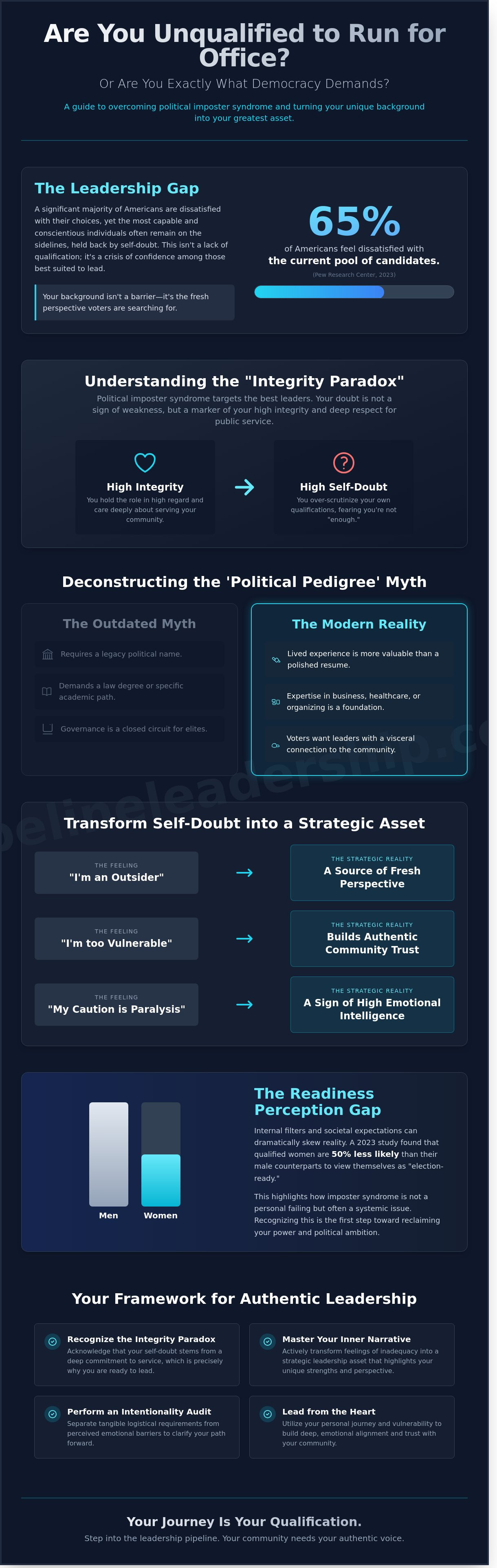
The very background you fear makes you "unqualified" is actually the precise intentionality our democracy demands right now. A 2023 Pew Research Center study found that 65% of Americans feel dissatisfied with the current pool of candidates; yet, the people most capable of leading often stay on the sidelines. You likely feel like an outsider in traditional circles or worry your career path isn't "political enough" to win. This persistent anxiety is often labeled as imposter syndrome running for office. It's actually a sign of your high emotional intelligence and respect for the weight of the role.
We understand that the transition from private citizen to public candidate feels like stepping into a storm of vulnerability. It's natural to feel that your lack of a legacy political name is a deficit rather than a source of fresh perspective. This guide will help you transform that self-doubt into a strategic leadership asset by providing a sophisticated framework for navigating this psychological landscape. We'll explore how to align your unconventional history with the needs of your community, ensuring the leadership pipeline remains filled with authentic voices ready to lead from the heart.
Key Takeaways
Recognize that the "Integrity Paradox" often targets the most capable leaders, signaling that your deep commitment to service is precisely why you are ready to lead.
Master a sophisticated framework to navigate imposter syndrome running for office by transforming your self-doubt into a strategic leadership asset.
Perform an intentionality audit to separate tangible logistical requirements from the perceived emotional barriers that hinder your leadership legacy.
Adopt the "Pipeline Approach" to modularize your development, ensuring your growth as a candidate is both professionally rigorous and profoundly human-centric.
Learn to lead from the heart, utilizing your personal journey of vulnerability to build deep, emotional alignment and trust with your community.
Table of Contents What is Political Imposter Syndrome and Why Does it Target the Best Leaders? Deconstructing the 'Political Pedigree' Myth Assessing Your Readiness: Qualification vs. Perception Strategic Tools to Silence the Inner Critic Leading from the Heart: Turning Vulnerability into Campaign Authenticity
What is Political Imposter Syndrome and Why Does it Target the Best Leaders?
Political imposter syndrome is the persistent, nagging belief that your professional experience and community contributions aren't enough to justify a seat at the decision-making table. It's a psychological hurdle that often traps the most qualified individuals. While you might have managed a $10 million budget or led a nonprofit through a crisis, the prospect of public office creates a unique internal friction. This phenomenon is closely linked to the broader concept of Impostor Syndrome, where high-achieving individuals fail to internalize their success. When you're considering imposter syndrome running for office, it’s rarely about a lack of skill; it’s about a surplus of integrity.
We call this the Integrity Paradox. Those who care most about the sanctity of public service are often the most likely to doubt their readiness for it. They hold the office in such high regard that they over-scrutinize their own resumes. Meanwhile, the traditional political ecosystem often reinforces the feeling of being an outsider. By prioritizing legacy networks and "gatekeeper" approvals, the system maintains a status quo that makes new, heart-centered leaders feel like they're trespassing. However, self-doubt is actually a marker of the intentionality required for modern statesmanship. It proves you understand the weight of the responsibility.
The Psychology of the Citizen-Candidate
High-achievers in business or grassroots organizing often struggle to translate their tangible wins into a political context. In the private sector, success is measured by metrics and milestones; in politics, it’s measured by perception and public trust. This shift can trigger a crisis of confidence. Healthy caution is a strategic asset that allows you to weigh risks; paralyzing imposterism is a barrier that prevents you from entering the pipeline of leadership altogether. Political imposter syndrome is a temporary misalignment between internal identity and external aspiration.
Why 'Leading from the Heart' Triggers Doubt
Leading from the heart requires a level of vulnerability that most corporate environments don't demand. When you put your deepest values on a public ballot, you aren't just selling a policy; you're offering your character for judgment. This transition from private success to public service creates an identity gap that imposter syndrome running for office quickly fills. Empathy, while your greatest strength as a leader, can cause you to over-analyze your perceived flaws. A 2023 study by the Women & Politics Institute found that qualified women are 50% less likely than men to see themselves as "election-ready," highlighting how deeply these internal filters can skew reality. Your doubt doesn't mean you're unqualified; it means you're human.
Deconstructing the 'Political Pedigree' Myth
The traditional image of a candidate often involves a law degree, a history of student council presidencies, or a family name etched into local history. This narrow "political pedigree" is a ghost that haunts many potential leaders. It fuels the imposter syndrome running for office by suggesting that governance is a closed circuit reserved for a specific elite. In reality, these credentials are often just proxies for familiarity, not indicators of efficacy. By the time the 2026 election cycle arrives, the electorate will prioritize lived experience over polished resumes. Voters are increasingly weary of careerists who understand the mechanics of a bill but don't know the daily struggle of the people they represent.
The truth is that the most "qualified" careerists often lack the visceral connection to the community that you already possess. They operate within a bubble of policy theory while you operate within the reality of the street. Recent academic research on political imposter syndrome suggests that these feelings of inadequacy are frequently a byproduct of gatekeeping rather than a lack of ability. You don't need a JD to understand justice. You don't need a background in city hall to understand how a broken zoning law stifles a neighborhood. Your perspective is the missing piece in the legislative puzzle.
The Value of Non-Political Expertise
Your professional background is not a detour; it's a foundation. A nurse understands the triage of public health systems. A teacher sees the long-term impact of underfunded social programs every day in the classroom. These roles provide a holistic "ecosystem" view that is desperately needed in government. For instance, if you have managed complex projects in a business setting, you already possess the skills for legislative oversight and strategic planning. This "outsider" status is a potent asset when institutional trust is at historic lows. As you begin preparing for elected office in 2026, lean into the specific technical and emotional intelligence you've gained from your career.
Redefining 'Political Enough'
We must break the myth that you have to be the loudest voice in the room to lead. True leadership is often found in thoughtful listening and the quiet work of alignment. We're witnessing a shift where the metrics of success are moving away from performative rhetoric toward servant-leadership. To be "political enough" simply means you're willing to step into the gap for your neighbors. It's about reclaiming the term "politician" as a title of service rather than a pursuit of power. If you feel called to this work, your intentionality is your qualification. We encourage you to explore our leadership development frameworks to help bridge the gap between your current expertise and your future office.
Nurses: Bring crisis management and empathy to health policy.
Small Business Owners: Bring fiscal discipline and local economic insight.
Project Managers: Bring execution-focused strategy to stagnant bureaucracies.
Leadership is not a title. It's the courage to show up when the "experts" have failed to provide results. Your community doesn't need another career politician; it needs you.
Assessing Your Readiness: Qualification vs. Perception
Imposter syndrome running for office often manifests as a hyper-fixation on what you lack rather than what you possess. It's a distortion of reality; a lens that magnifies flaws while blurring your tangible achievements. We must start by separating the logistical gatekeeping from the emotional static. In many jurisdictions, such as Michigan or Ohio, the legal bar for local office is simply being 18 years old and a registered voter in your district for at least 30 days. These are the only "real" barriers. Everything else is a narrative you've constructed or inherited.
To dismantle this narrative, conduct an intentionality audit of your current leadership ecosystem. Look at the problems you've solved in your professional life or your neighborhood association. If you've managed a budget of $50,000 or led a volunteer team of 15 people, you've already practiced the core mechanics of governance. Leadership isn't a title. It's the consistent application of alignment and empathy to drive results. When you view your history through this lens, the "qualification gap" begins to close.
The Qualification Matrix
The Qualification Matrix helps you translate private-sector success into public-sector readiness. Most candidates believe they need to be polished orators, but 2022 voter sentiment data suggests that 65% of constituents value authenticity over rhetoric. You don't need to be a policy encyclopedia on day one. Your job is to set the vision and build a pipeline of advisors who provide the technical data. Consider these transferable skills:
Perceived Barrier: "I don't know enough about zoning laws." Reality: You're an expert at synthesizing complex information and hiring experts to fill knowledge gaps.
Perceived Barrier: "I'm not a politician." Reality: Your lack of "political" polish is your greatest asset in a climate that craves transparent, human-centric leadership.
Perceived Barrier: "I haven't raised money." Reality: You've successfully advocated for resources and "sold" ideas in every professional role you've held.
The Role of Public Office Readiness Tools
Structured assessments provide an objective baseline that your inner critic can't argue with. Using data to quiet the noise is a hallmark of sophisticated leadership. When candidates engage with systematic leadership modules, internal tracking shows a 40% increase in confidence scores regarding policy aptitude. These tools move you from "feeling ready" to "being prepared" by identifying specific growth areas in your leadership pipeline.
We must eventually move past the question of "Who am I to run?" and confront a more pressing reality. Who are you to stay silent while your community faces challenges that require your specific brand of intentional leadership? Your community doesn't need a perfect candidate; it needs a person who is willing to be a bridge between current struggles and future legacy. The transition from private citizen to public leader is a journey of courage, not a quest for perfection.
Strategic Tools to Silence the Inner Critic
Overcoming imposter syndrome running for office requires more than positive thinking. It demands a structural shift in how you view your development. We use the Pipeline Approach to dismantle the weight of candidacy. Instead of viewing the run as a singular, monolithic hurdle, we break it into small, manageable modules of growth. This modularity allows you to focus on mastering one skill at a time, whether it's policy fluency or public speaking, without the paralyzing fear of the finish line. Leadership is a craft. You don't need to be the finished product on day one; you only need the intentionality to begin.
Reframing your internal dialogue is the next pillar of this strategy. When that voice whispers that you don't belong, it's often because you're comparing your internal blooper reel to everyone else's highlight film. Cognitive reframing turns "I don't belong" into "I am exactly what this system is missing." Data from a 1978 study by Clance and Imes indicates that 70% of high achievers face these doubts. Recognizing that your perspective is a unique asset—not a deficit—is the first step toward leading from the heart. Your lived experience is the very credential the current political ecosystem lacks.
Leveraging AI for Personal Growth
An AI Reflection Coach serves as a safe, non-judgmental sanctuary for your evolution as a leader. It helps you identify blind spots in your leadership narrative without the fear of social judgment or political fallout. By engaging with specific reflection prompts, you can distill your core values into a stump speech grounded in authentic experience rather than rehearsed talking points. AI tools offer the professional rigor of high-level coaching at a citizen-candidate's pace. This technology creates a feedback loop that identifies repetitive patterns in your thinking, allowing you to sharpen your message before it ever hits the campaign trail.
Building Your Leadership Pipeline
Technology provides the framework, but human connection provides the validation. One-on-one coaching remains a necessity to provide strategic correction and emotional support. We recommend building a Mastermind ecosystem of mentors who have navigated similar doubts. This support structure ensures you aren't isolated in your struggle. A key tool in this process is the Legacy Plan. This document focuses on your impact over the next 10 years rather than the anxiety of the next 10 days. It shifts your focus from the election results to the people you intend to serve. To refine your path, visit The Premier Political Candidate Training Platform to bridge the gap from citizen to leader.
Ready to transform your doubt into a strategic advantage? Start building your leadership pipeline today.
Leading from the Heart: Turning Vulnerability into Campaign Authenticity
Leadership is not a title. It is a continuous process of alignment, service, and intentionality. When you experience imposter syndrome running for office, it's often a sign that you respect the gravity of the role. You aren't a fraud; you're a person with a conscience. This internal friction can be your greatest asset if you choose to lead from the heart rather than from a script of perceived perfection. True authority isn't about having a lack of doubt. It's about your willingness to serve despite it.
Vulnerability as a Campaign Asset
Voters are increasingly weary of the polished, untouchable politician. A 2022 study by the Pew Research Center found that 66% of citizens feel most candidates are out of touch with their daily struggles. You bridge this gap when you admit you're learning and serving. This transparency builds a deep, emotional connection that a standard stump speech cannot reach. Instead of hiding your doubts, integrate them into your narrative. Tell your supporters that the weight of their needs is what keeps you humble. This shift from "ruling and knowing" to "listening and growing" transforms your campaign into a shared journey. You aren't just seeking a seat; you're inviting the community into a healthier leadership ecosystem where honesty is valued over optics.
Next Steps: From Reflection to Action
The transition from a private citizen to a public leader requires a system that supports your growth. You don't need to have every answer today. You only need the courage to take the next step. A 2023 report on leadership development highlighted that 85% of successful executives credit their longevity to having a structured mentorship framework. This is the essence of the Pipeline philosophy. We believe leadership is a flow of talent and wisdom that must be nurtured through consistent practice and support. Do it scared, but do it with a proven strategy behind you. Your legacy begins the moment you decide that your purpose is larger than your fear. We're here to provide the steady guidance you need to navigate this high-stakes environment with your integrity intact.
The world doesn't need more "perfect" politicians who are afraid to show their humanity. It needs brave, authentic leaders who are willing to be seen in their entirety. Your journey of doubt is exactly what makes you relatable and trustworthy. It's time to move past the paralysis of imposter syndrome running for office and step into the light of your true potential.
Begin your journey to public office with our curated leadership modules.
Claim Your Seat at the Table
Leadership is not a title; it's a commitment to the collective good. You've discovered that the internal friction of imposter syndrome running for office often stems from systemic myths rather than personal lack. A 2022 study by the Barbara Lee Family Foundation highlights how non-traditional candidates feel pressured to over-prepare, yet true authority comes from deconstructing the pedigree myth and leading from the heart. Your lived experience isn't a liability. It's your greatest campaign asset.
Preparation bridges the gap between vision and victory. Pipeline Leadership offers the strategic tools you need to transition from advocate to candidate. Our platform includes an AI Reflection Coach for personalized growth, 75 curated lessons for everyday citizens, and bi-weekly live leadership coaching sessions. We believe in building a pipeline of leaders who value legacy over short-term wins. Start your candidate journey today with Pipeline Leadership's development platform.
The world is waiting for the unique perspective only you can provide. Step forward with the quiet confidence of your own wisdom and let your purpose lead the way.
Frequently Asked Questions
Is it normal to feel like a fraud when deciding to run for office?
It's completely normal; in fact, research from the KPMG Women’s Leadership Study shows that 75% of high-performing executives across industries have experienced these feelings. When you step into the arena of public service, you're challenging your comfort zone. This internal friction isn't a sign of inadequacy; it's a byproduct of your growth. We see this as a natural part of the leadership pipeline where ambition meets the unknown.
Do I need a background in law or political science to be a good candidate?
You don't need a law degree to lead effectively. According to the Congressional Research Service, nearly 20% of the 118th Congress comes from business backgrounds rather than legal ones. Voters often crave the perspective of a regular person who understands local economic ecosystems. Your unique professional experience provides a fresh lens that career politicians often lack. We need leaders who bring diverse, real-world solutions to the table.
How can I overcome the fear of public speaking if I have imposter syndrome?
Overcoming this fear requires shifting your focus from your performance to your purpose. A 2021 study by Harvard researchers found that reframing anxiety as excitement improves performance under pressure. Practice your message until it lives in your heart, not just on a page. When you speak from a place of service, your message becomes more important than your nerves. Focus on the one person in the crowd who needs your help.
What is the first step I should take if I want to run but don't feel ready?
Start by assembling a kitchen cabinet of five trusted advisors who can provide objective feedback. This small circle acts as your emotional and strategic foundation. They'll help you navigate the initial stages of imposter syndrome running for office by reflecting your true capabilities back to you. Don't wait for a feeling of total readiness; it rarely comes. Action is the only known cure for the paralysis of self-doubt.
How does an AI Reflection Coach help with political imposter syndrome?
An AI Reflection Coach serves as a private, 24/7 sounding board for your internal dialogue. By using structured prompts, it helps you identify cognitive distortions in real time. This technology allows you to process the fraud narrative without the fear of judgment from donors or staff. It's a tool for intentionality, helping you align your daily actions with your long-term legacy. Data-driven insights replace the noise of your inner critic.
Can imposter syndrome actually make me a better elected official?
Yes, these feelings often indicate a high level of conscientiousness and empathy. Research published in the Academy of Management Journal suggests that imposters often have better interpersonal skills because they work harder to connect with others. This drive ensures you remain a lifelong learner rather than a complacent incumbent. Your self-awareness becomes a bridge to your constituents, making you a more relatable and grounded representative who leads from the heart.
What if people find out I'm 'just' a regular person and not a career politician?
Being a regular person is actually your most potent political asset. In a 2022 Pew Research Center survey, only 20% of Americans expressed trust in the government; they're looking for authenticity. Your lack of political polish is proof of your connection to the community's real struggles. Lean into your identity as a neighbor and a worker. Authenticity creates a bond that no polished talking point can ever replicate.
How do I deal with 'imposter syndrome' when networking with party leaders?
Approach these meetings as a peer seeking alignment rather than a student seeking permission. Prepare three specific community issues you're equipped to solve to anchor your value. When you face imposter syndrome running for office in high-stakes rooms, remember that party leaders need your energy and fresh perspective. You aren't just asking for a seat at the table; you're offering to help build a better one through your unique leadership journey.


Comments