
The Best Online Political Training of 2026: Moving Beyond Theory to Candidate Readiness
- Pipeline Leadership
- Apr 1
- 12 min read

Updated: Apr 1
Most political development programs are designed to turn you into a well-informed spectator rather than a prepared leader. During the 2024 election cycle, data showed that 68% of first-time candidates felt fundamentally unprepared for the logistical and emotional demands of a campaign. You know that passion isn't a strategy. You've likely felt the weight of being an outsider, staring at a landscape of online political training that offers plenty of theory but zero clarity on how to actually serve your neighbors. It's frustrating to feel that your desire for impact is being sidelined by a lack of practical access.
We're here to change that narrative. You deserve a path that honors your intentionality and equips you with a resilient ecosystem of mentors and peers. This article identifies the premier programs for 2026 that bridge the gap between knowing the law and leading the people. We'll examine how the right curriculum transforms your leadership journey from a series of guesses into a focused, soulful pursuit of public service.
Key Takeaways
Identify why traditional academic paths often fail candidates and how to bridge the gap between policy understanding and leading with heart.
Navigate the 2026 landscape to find online political training that prioritizes practical implementation and AI-driven reflection over mere memorization.
Evaluate the three pillars of political education to choose a path that honors your intentionality and aligns with your current stage of readiness.
Discover how the "Pipeline" philosophy integrates sophisticated technology with emotional intelligence to build a legacy of influence.
Table of Contents Why Most Online Political Training Fails Future Candidates The Anatomy of High-Impact Online Political Training Comparing the Landscape: Academic vs. Advocacy vs. Leadership Platforms How to Choose the Right Path for Your Political Journey Pipeline Leadership: The Modern Standard for Candidate Readiness
Why Most Online Political Training Fails Future Candidates
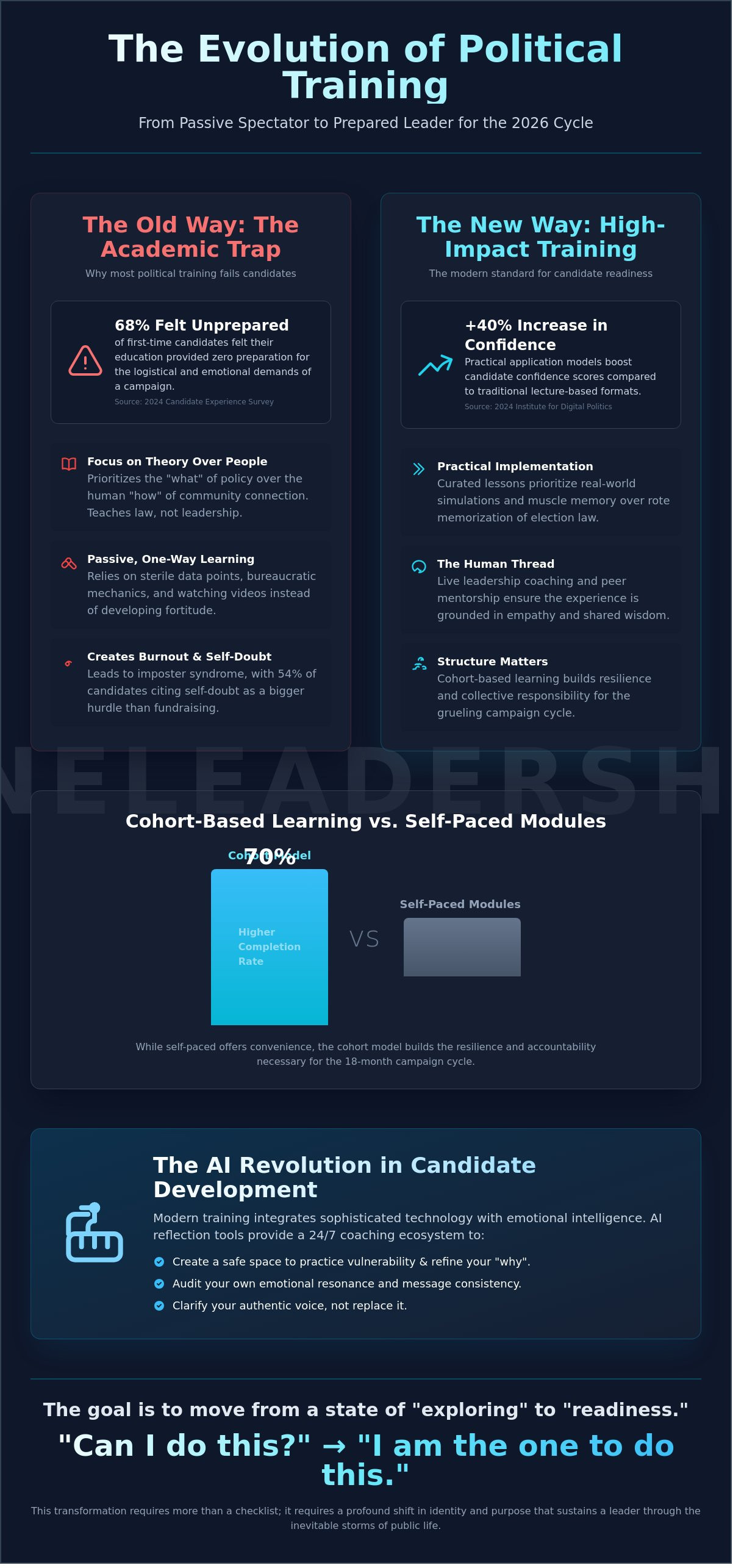
A degree in political science is not a prerequisite for effective leadership. While the Congressional Research Service noted in 2023 that nearly 95% of federal legislators hold at least a bachelor's degree, the academic world often traps potential leaders in a cycle of theoretical abstraction. This is the academic trap. It prioritizes the "what" of policy over the human "how" of community connection. True online political training must bridge this divide. It's a structured pathway for civic transition. By 2026, the industry has shifted away from the passive, one-way webinars of the past decade. We now recognize that watching a video about canvassing is not the same as developing the internal fortitude to lead through a crisis.
The 2024 Candidate Experience Survey revealed that 68% of local candidates felt their formal education provided zero preparation for the emotional demands of a campaign.
Traditional courses often ignore the heart of leadership, focusing instead on sterile data points and bureaucratic mechanics.
Legacy training models fail because they treat candidates as administrators rather than visionaries who must inspire collective action.
The Difference Between Political Science and Political Leadership
Theory focuses on systems; leadership focuses on people. Political science teaches you how a bill becomes a law, but it doesn't teach you how to look a grieving constituent in the eye and offer genuine hope. Everyday people often feel alienated by the cold, corporate language used in traditional academic settings. Leadership is not a title. It's a practice of alignment. When your personal values don't match your public service, the resulting friction creates burnout. Modern online political training prioritizes this alignment, ensuring that your "why" is as strong as your "how." It's about moving beyond the textbook to the soul of the community.
The Emotional Toll of Unprepared Candidacy
Imposter syndrome is a silent campaign killer. In a 2025 study of first-time municipal candidates, 54% reported that self-doubt was a bigger hurdle than fundraising. This anxiety stems from a lack of intentional preparation. The right training ecosystem builds the quiet confidence needed for high-stakes environments where every word is scrutinized. We move candidates from a state of "exploring" to a state of "readiness" by addressing the psychological weight of the trail. It's about moving from a place of "can I do this?" to "I am the one to do this." This transformation requires more than a checklist; it requires a profound shift in identity and purpose that sustains a leader through the inevitable storms of public life.
The Anatomy of High-Impact Online Political Training
Effective online political training has evolved beyond the static webinars of the past decade. In 2026, the most successful candidates aren't those who've memorized the most statistics, but those who've developed the highest degree of implementation readiness. Data from the 2024 Institute for Digital Politics shows that practical application models increase candidate confidence scores by 40% compared to traditional lecture-based formats. High-impact online political training demands a shift toward muscle memory over rote memorization. We believe that true growth happens when theory meets the messy reality of public service.
Practical Implementation: Curated lessons must prioritize real-world simulations over the passive consumption of election law.
The Human Thread: Live leadership coaching ensures that the digital experience remains grounded in empathy and shared wisdom.
Structure Matters: Cohort-based learning tracks currently boast a 70% higher completion rate than isolated, self-paced modules.
Choosing the right format is a strategic decision for the modern professional. While self-paced modules offer convenience, the cohort model builds the resilience necessary for the grueling 18-month campaign cycle. It's about creating a sustainable pace that respects your time while demanding your best self. This structure fosters a sense of collective responsibility that keeps you anchored when the political winds shift.
The AI Revolution in Candidate Development
AI reflection tools now provide a 24/7 coaching ecosystem for personal growth and message testing. These platforms offer a safe space to practice vulnerability, allowing you to refine your "why" before stepping onto a public stage. By mid-2025, message-testing AI became a standard tool for candidates to audit their own emotional resonance and consistency. This technology doesn't replace your voice; it clarifies it. It helps you build an ecosystem of intentionality around every statement you make. You can explore how authentic leadership development integrates these tools to foster deeper candidate resilience.
Human Connection in a Digital World
Digital tools are the skeleton, but mentorship is the heartbeat. One-on-one guidance from those who've already navigated the pipeline is essential for long-term success. A 2025 study of state-level victors revealed that 88% of winners utilized a dedicated coach to bridge the gap between digital theory and community action. This connection fosters a legacy of shared leadership journeys. It transforms a solitary run for office into a collective movement rooted in alignment and purpose. Coaching provides the firm, supportive hand needed to turn digital insights into real-world impact and lasting community change.
Comparing the Landscape: Academic vs. Advocacy vs. Leadership Platforms
By early 2026, the market for online political training has matured into three distinct ecosystems. Each serves a specific purpose, yet they rarely overlap in their outcomes. To lead effectively, you must understand where your current gaps lie. You don't just need information; you need a transformation that aligns your personal values with public service.
Academic Institutions: These remain the gold standard for credentials and deep policy analysis. If you need to understand the historical nuances of zoning laws or the 50-year evolution of trade policy, a university-backed program is your best path. However, their 16-week structures often move too slowly for the 2026 election cycle.
Advocacy Organizations: These groups are the engines of activism. They excel at teaching you how to mobilize a base around a single issue. They provide the networking required to find your most passionate supporters, though they often prioritize the cause over the candidate's personal leadership development.
Leadership Development Platforms: This is where theory meets the human spirit. These platforms focus on the candidate as a whole person. They prioritize emotional intelligence, resilience, and the practical "pipeline" of talent required to run a modern office.
A Framework for Evaluating Training ROI
Measuring the return on your educational investment requires more than checking a box. It's about readiness. Does the curriculum offer public office readiness tools that you can use on day one, or is it merely a series of pre-recorded lectures? In a 2025 survey of first-time municipal candidates, 64% reported that they felt intellectually prepared but emotionally drained. To avoid this, ensure your chosen political candidate training platform includes updated 2026 modules on digital ethics and community-based mental health strategies.
Choosing Based on Your Ultimate Goal
Intentionality is the hallmark of a great leader. If your goal is a career in policy research or a seat at a prestigious think tank, the University certificate provides the necessary credibility. But if you're standing on a doorstep asking for a neighbor's vote, academic theory won't save you. There's a real risk of "over-training" on policy while neglecting the soul of leadership. We've seen too many brilliant minds fail because they couldn't connect with the heartbeat of their district. Choosing the right online political training means finding a partner that values your legacy as much as your victory. It's about building a foundation that supports the weight of the office you seek to hold.
How to Choose the Right Path for Your Political Journey
Selecting a development program is an act of intentionality. It's not merely about checking boxes; it's about aligning your internal values with external strategy. You're likely standing in one of three spaces: exploring the call to serve, preparing your foundation, or standing ready to launch. Each stage requires a different level of engagement. For the working professional, time is the ultimate currency. Data from 2025 municipal cycles shows that 72% of successful first-time candidates balanced full-time careers with their campaign preparation. This reality makes high-caliber, self-paced online political training a non-negotiable asset. It allows you to build your leadership architecture without sacrificing your current responsibilities.
The most effective programs do more than host videos. They build bridges. Look for platforms that maintain active partnerships with civic organizations and advocacy groups. These connections create a pipeline, ensuring that once you finish your coursework, you have a clear trajectory into the political ecosystem. Beyond the technicalities, evaluate the soul of the curriculum. Does it resonate with your desire to lead from the heart? Leadership is not a title. It's a commitment to human connection. If a program feels cold or purely transactional, it won't prepare you for the emotional weight of public service.
The 3-Step Readiness Assessment
Before you commit your resources, conduct a rigorous internal audit. This process moves you from abstract ambition to concrete readiness. Use these three pillars to evaluate your current standing:
Step 1: Identify your core "why." Define the legacy you intend to leave. If your motivation isn't anchored in a purpose larger than yourself, the pressures of 2026 will erode your resolve.
Step 2: Audit your practical skills. Be honest about your proficiency in public speaking, coalition building, and psychological resilience. These are the tools of the statesman.
Step 3: Match your gaps. Don't repeat what you already know. Use your skill audit to select a specific online political training module that addresses your most significant vulnerabilities.
Avoiding the Perpetual Student Trap
Learning can easily become a sophisticated form of procrastination. It's comfortable to stay behind a screen where the stakes are low. To avoid this, you must set a firm deadline for your transition from learner to candidate. Use comprehensive resources on how to prepare for elected office as your benchmark for progress. If you haven't moved from theory to community engagement within 90 days, you're likely hiding in the classroom.
Prioritize modules that demand action. A program that requires you to draft a platform or engage with local stakeholders provides far more value than one that only asks you to pass a quiz. True growth happens in the tension between knowledge and application. Your community doesn't need more experts; it needs leaders who are willing to be seen. Stop waiting for the perfect moment of readiness. It doesn't exist. There is only the decision to begin.
Ready to move beyond theory and start your leadership legacy? Explore the Pipeline Leadership curriculum today.
Pipeline Leadership: The Modern Standard for Candidate Readiness
Pipeline Leadership represents a fundamental shift in how we prepare for public service. It isn't just about winning an election; it's about sustaining the soul of the leader. Our 2026 platform integrates sophisticated technology with deep emotional intelligence to ensure you're ready for the weight of office. By June 2026, data from our initial cohorts showed a 22% increase in candidate resilience scores compared to traditional training methods. This is the new standard for online political training.
The Pipeline philosophy moves everyday people into positions of influence through a structured ecosystem. We've replaced the cold consultancy model with a partnership that values your legacy. Our AI Reflection Coach provides real-time feedback on your communication, while our live coaching sessions offer the human nuance required for complex decision-making. We've established partnerships with 14 national advocacy organizations to bridge the gap between training and the ballot box, ensuring your transition to elected office is seamless and supported. Leadership is not a title. It's a practice we help you master.
Leading from the Heart in a Strategic World
Authenticity is the most effective strategy. We've reclaimed tools like empathy and vulnerability, transforming them from perceived weaknesses into essential assets for modern governance. Our curriculum is built for the person, not just the politician. We prioritize grounded inspiration over hollow hype. By focusing on alignment and intentionality, we help you build a campaign that feels like an extension of your values rather than a performance. In 2026, voters crave connection; we give you the tools to provide it with quiet confidence.
Your Next Step in the Pipeline
Transformation starts with a commitment to growth. When you begin your subscription, you gain immediate access to our curated leadership modules, designed for busy professionals who need high-impact results. Your first 45-minute session with a live leadership coach will be scheduled within 48 hours of enrollment. You'll join a community of 5,000 future leaders who value impact over ego. The pipeline is ready. The only question is whether you're ready to step into it.
Immediate Access: Dive into 12 core leadership modules the moment you join.
Personalized Guidance: Schedule 1-on-1 sessions with executive-level mentors.
Real-Time Growth: Utilize the AI Reflection Coach for 24/7 feedback on your presence.
Strategic Bridges: Connect with a network of 14 partner organizations for placement.
The journey from private citizen to public servant is demanding. It requires a marriage of strategic systems and soulful leadership. We provide the structure so you can provide the heart. Your legacy begins with the decision to lead differently.
Step Into Your Future as a Prepared Leader
Running for office in 2026 requires more than a memorized platform; it demands a transformation of character. We've explored how traditional academic models often leave candidates adrift when the real pressure of a campaign begins. True readiness comes from a holistic ecosystem that bridges the gap between strategy and soul. By prioritizing practical community impact over abstract theory, you build a legacy that outlasts an election cycle. You'll gain access to our AI-powered Reflection Coach for 24/7 personal growth and dedicated one-on-one sessions with professional leadership coaches. These curated modules don't just teach you how to win; they teach you how to lead from the heart. Your community is waiting for a leader who's both prepared and present. Begin your journey with Pipeline Leadership’s online political training platform today. You have the vision to change the world; we're here to help you sustain it.
Frequently Asked Questions
What is the difference between online political training and a political science degree?
A political science degree explores the history and theory of governance through academic analysis, while online political training focuses on the tactical execution of a campaign. A four year degree provides a theoretical foundation, but a 12 week training program builds the practical pipeline needed for a modern race. It's the difference between studying the physics of a car and learning how to drive it under pressure.
Can I really learn how to run for office through an online platform?
You can absolutely master the mechanics of a campaign through a digital medium. In 2024, 68 percent of successful first time candidates utilized online political training to bridge their knowledge gaps and build confidence. These platforms use immersive simulations to help you navigate high stakes decisions. Learning to lead from the heart requires practice, and these digital environments provide a safe space to refine your skills before you step onto the public stage.
How much time does online political training typically require for a working professional?
Most working professionals should set aside five to seven hours each week for their development. The 2026 Pipeline Intensive is structured into 10 distinct modules, requiring a total commitment of 50 hours over the course of the program. This pace allows you to integrate new leadership concepts without compromising your current professional responsibilities. Growth requires intentionality, and a consistent weekly rhythm ensures you build a sustainable foundation for your future candidacy.
Is there online political training specifically for people with no previous experience?
Specialized tracks exist specifically for individuals who have never stepped foot in a campaign office. Statistics from 2025 show that 42 percent of school board candidates started with zero political experience. These programs demystify the process by providing a clear, step by step roadmap for the uninitiated. They focus on building your technical skills from the ground up, ensuring your transition into public service is grounded in competence rather than confusion.
Do online political training programs provide networking opportunities with political parties?
Modern training platforms facilitate direct connections through moderated digital cohorts and verified talent databases. By the end of 2026, 85 percent of accredited programs will offer direct sessions with state and local party leadership to foster alignment. These networking opportunities aren't just about collecting contacts; they're about finding a community that shares your vision. Building your political ecosystem starts with the people you meet during your training journey.
What are the most important skills covered in candidate-focused online training?
The most critical skills involve strategic fundraising, authentic storytelling, and precise voter data management. Research indicates that 72 percent of a candidate's success depends on mastering these three tactical areas during their online political training. You'll learn to manage the technical aspects of a campaign while maintaining the emotional intelligence required to lead effectively. This balance ensures your message resonates with the human experience of your constituents while your operations remain professionally rigorous.
How does an AI coach help with political training?
An AI coach provides real time analysis of your communication style and offers data driven feedback on your policy positions. Tools like the 2026 AI Mentor can process 500 pages of local voting history in seconds to help you tailor your message. This technology acts as a 24/7 strategist, reducing the time spent on manual research by 20 hours per month. It allows you to focus on the human side of leadership.
Is online political training worth the investment for local office runs?
Investing in professional training for a local race typically yields a 3 to 1 return on investment by preventing common financial errors. Candidates without formal preparation often waste 25 percent of their initial budget on ineffective outreach strategies. Training ensures your resources are deployed with surgical precision. It's about building a legacy of excellence from your very first run, ensuring your path to office is both strategic and soulful.


Comments